

Kalshi Fees 2026: Complete Guide to Trading, Deposit & Withdrawal Costs
Kalshi's peak taker fee is 1.75%, but most trades cost far less. Here's the full P×(1-P) formula, category-by-category fees, maker rebates, and how to keep your costs under 0.5% per trade.
Kalshi advertises itself as the regulated, US-legal way to trade event contracts — and on fees, it's competitive with offshore venues most of the time. But the fee schedule isn't a single number, and the headline "1.75%" you sometimes see quoted only applies to a specific scenario most traders never hit. This guide breaks down exactly what you pay on Kalshi in 2026, what the formula means in practice, and how to structure trades so your effective fee stays well under half a percent.
The Headline: What Kalshi Actually Charges
Kalshi uses a single formula for every market, with a category-specific multiplier baked in. The published taker fee is:
fee per contract = round(multiplier × price × (1 − price), 2)
Where multiplier is between 0.07 (for most categories) and a higher value for premium markets like Crypto. The fee is rounded to the nearest $0.01 per contract.
Three things follow from that formula:
- The fee is highest at 50¢. That's where
p × (1−p)peaks at 0.25. A 7% multiplier at 50¢ works out to a peak fee of 1.75% of contract value. - The fee tapers toward zero at the extremes. A 10¢ contract has
p × (1−p) = 0.09, so the same multiplier produces a fee of just 0.63% — about a third of the peak. - The fee is proportional to risk, not size. Kalshi's argument is that contracts near 50/50 odds carry more uncertainty, so they deserve a higher fee per dollar of exposure. Whether you accept that argument or not, it's how the math shakes out.
The same curve applies on the way down. At 90¢, p × (1−p) = 0.09 again, so a 7% multiplier produces a 0.63% fee. The shape is a symmetric parabola peaking at 50¢.
The Real Numbers: Peak Fees by Category
Kalshi doesn't apply the same multiplier everywhere. Here's what you actually pay at the peak (50¢) by category, based on the most recent Kalshi fee schedule:
| Market Category | Peak Taker Fee (at 50¢) | Fee at 80¢ or 20¢ | Fee at 95¢ or 5¢ |
|---|---|---|---|
| Sports | ~1.5% | ~0.96% | ~0.29% |
| Economics | ~1.5% | ~0.96% | ~0.29% |
| Politics | ~1.4% | ~0.90% | ~0.27% |
| Crypto | ~1.75% | ~1.12% | ~0.33% |
| Climate / Weather | ~1.4% | ~0.90% | ~0.27% |
| Culture & Entertainment | ~1.4% | ~0.90% | ~0.27% |
These are taker fees, applied when your order crosses the spread and fills against a resting limit order. If you place a limit order yourself and wait for someone else to take the other side, the maker fee is materially lower — usually zero or rounded down to $0.00 per contract for trades under a certain size.
Concrete example. You buy 1,000 shares of a Sports YES contract at 50¢ with a market order:
- Contract cost: 1,000 × $0.50 = $500
- Taker fee at 50¢ with ~6% multiplier: 1,000 × $0.06 × 0.5 × 0.5 = $15
- Effective fee rate: $15 / $500 = 3.0% of capital risked (1.5% of contract value)
That 3.0%-of-capital-risked number is the one that should anchor your intuition — not the 1.5% headline. When you risk $500 to maybe win $500, paying $15 in fees means you need to be right 51.5% of the time just to break even before edge. On marginal trades, this matters a lot.
Maker vs Taker: Why Limit Orders Are Almost Free
Like every modern exchange, Kalshi differentiates between:
- Takers: traders who place market orders or limit orders that immediately fill against the existing book. Takers pay the full fee.
- Makers: traders who place limit orders that rest on the book until someone else trades against them. Makers add liquidity, and exchanges reward this with reduced (or zero) fees.
Kalshi's maker fee schedule produces a fee of effectively $0.00 per contract for most small trades because of the rounding step. For an institutional-size maker order, you might pay a small fraction of a cent per contract — still well under what takers pay.
The practical implication: if you're trading systematically and you can wait for fills, place limit orders. The expected cost is near zero. If you need to get in immediately, you pay the taker fee.
For retail traders, the biggest objection is "what if my limit order never fills?" — and it's a real concern in thin markets. But Kalshi's most popular sports and political markets have tight enough spreads that resting a limit one tick off the touch typically fills within minutes. The trade-off is a few extra ticks of price uncertainty in exchange for paying zero fees on every trade you do execute.
Deposit Fees: ACH Is Free, Wires Cost More
Kalshi accepts deposits through several methods. The cost of getting money in is set by the payment processor, not by Kalshi itself:
| Deposit Method | Fee | Notes |
|---|---|---|
| ACH bank transfer | Free | 3–5 business days for new accounts; instant once verified |
| Wire transfer | $0–$30 (your bank's fee) | Same-day funding |
| Debit card | ~3% (processor fee) | Instant, but expensive |
| Apple Pay / Google Pay | ~3% (processor fee) | Instant, expensive |
The rational choice for almost everyone is ACH. Wire fees eat into small deposits, and card processors charge 3% which is more than most traders pay in trading fees over a typical month. The one exception is when you're trying to fund a fast-moving market and ACH delay would make you miss the trade — in that case, eating the wire or card fee is sometimes worth it.
Withdrawal Fees: Kalshi Charges Nothing
Kalshi withdrawals via ACH are free. The funds typically arrive in your bank account in 1–3 business days. There's no withdrawal minimum and no monthly limit on the number of free withdrawals.
Wire transfers out cost roughly $25–$30 depending on the receiving bank. Most retail traders never need wires — ACH is free, fast enough, and works for any reasonable withdrawal size.
This is a meaningful contrast with Polymarket Global, where withdrawing requires bridging USDC out of the deposit smart contract, paying Polygon gas (small) and then potentially CEX deposit/withdrawal fees on top to convert back to fiat. Kalshi's flow is a single ACH transfer, end to end.
Volume Discounts and Pro Trader Pricing
Kalshi has introduced volume-based fee tiers for high-frequency and institutional traders. The exact tier breakpoints aren't published publicly the way they are on a CME or CBOE, but the general structure is:
- Retail tier: standard fees as described above.
- Active trader tier: discounted taker fees for accounts trading above a monthly volume threshold.
- Market maker programs: dedicated rebate structures for designated market makers in specific contracts.
If you're trading more than a few thousand dollars per day in notional volume, it's worth emailing Kalshi support to ask about active trader pricing. Most users won't qualify, but the cutoff is lower than you might expect on lower-volume markets.
How Kalshi Compares to Polymarket on Real Trades
The fairest way to compare is dollar-for-dollar on identical trades. Here are three scenarios:
Scenario 1: Politics market at 60¢, buy 500 shares
| Platform | Taker Fee | Notes |
|---|---|---|
| Kalshi | ~$3.36 (≈1.12%) | 6% multiplier × 0.6 × 0.4 × 500 shares |
| Polymarket Global | ~$2.40 (≈0.80%) | 4% multiplier × 0.6 × 0.4 × 500 shares |
| Polymarket US | $0.90 (0.30%) | Flat 0.30% taker fee |
Scenario 2: Sports market at 45¢, buy 1,000 shares
| Platform | Taker Fee | Notes |
|---|---|---|
| Kalshi | ~$14.85 (≈3.3% of capital, 1.65% of contract) | 6% × 0.45 × 0.55 × 1,000 |
| Polymarket Global | ~$7.43 (≈1.65% of capital) | 3% × 0.45 × 0.55 × 1,000 |
| Polymarket US | $1.35 (0.30% of contract) | Flat 0.30% taker fee |
Scenario 3: Crypto market at 25¢, buy 800 shares
| Platform | Taker Fee | Notes |
|---|---|---|
| Kalshi | ~$10.50 (≈1.31% of contract) | 7% × 0.25 × 0.75 × 800 |
| Polymarket Global | ~$10.80 (≈1.35% of contract) | 7.2% × 0.25 × 0.75 × 800 |
| Polymarket US | $0.60 (0.30% of contract) | Flat 0.30% taker fee |
The pattern: Polymarket Global is cheaper on sports and roughly comparable elsewhere. Polymarket US is materially cheaper than Kalshi on essentially every trade — but Polymarket US has narrower market selection and tighter liquidity in most non-political markets.
Where Kalshi wins is on selection, regulatory certainty, and ease of funding. The fee gap to Polymarket Global is usually small enough that the convenience and CFTC oversight is worth it for many traders.
Strategies to Minimize Your Effective Kalshi Fee
Five tactics that meaningfully cut what you actually pay:
- Place limit orders, not market orders. Maker fees are effectively zero. Even a one-tick improvement over the touch usually fills within a few minutes on liquid contracts.
- Avoid 50¢ contracts when possible. The fee curve peaks there. The same probabilistic insight expressed as a 30¢/70¢ trade costs roughly half as much in fees.
- Concentrate trades. Five large trades cost less in fees than fifty small ones because of the $0.01-per-contract rounding floor. If you're DCA-ing a position, batch your entries.
- Use ACH, not cards. A single 3% card deposit fee on $1,000 erases a year's worth of careful fee optimization on small trades.
- Check the cross-platform price before clicking. Compare prices on Kalshi vs Polymarket vs other venues for the same market — if Polymarket is offering a 1¢ better price, the fee difference often disappears.
Kalshi Sports Markets: A Special Case
Kalshi's expansion into sports event contracts in 2025 brought a new fee dynamic. Sports markets are some of Kalshi's highest-volume, and the fee math matters more because sports traders typically trade more frequently than political traders.
A few quirks specific to sports:
- Live (in-game) markets carry the same fee schedule as pre-game markets. Liquidity is generally thinner during live windows, so spreads widen — but the per-contract fee formula doesn't change.
- Player prop markets sometimes use slightly different multipliers than team-level markets. Always confirm in the order ticket before submitting.
- Combos / parlays on Kalshi have their own fee schedule — typically a single fee on the combined contract rather than fees stacked across legs. See our Kalshi parlays guide for the full mechanics.
Frequently Misunderstood: The "Risk-Adjusted" Fee
The fee being expressed as a percentage of contract value (not capital risked) is the single most common source of confusion in Kalshi fee discussions. Two examples to ground the intuition:
Buying YES at 10¢: You pay 10¢ for a contract that pays $1.00 if YES resolves true. Your capital at risk is 10¢. A 0.63% contract-value fee = 0.63¢. As a percentage of capital risked, that's 6.3%.
Buying YES at 50¢: You pay 50¢ for the same $1.00 max payout. Your capital at risk is 50¢. A 1.75% contract-value fee = 0.875¢. As a percentage of capital risked, that's 1.75%.
Both fees are "fair" by Kalshi's logic (proportional to outcome uncertainty), but a heavy small-stake-on-longshots strategy pays a much higher effective rate on your capital than a strategy that concentrates on 40–60¢ contracts. If you're explicitly hunting longshots on Kalshi, factor in the 5–10% effective fee on capital before betting.
Bottom Line
Kalshi is not a free exchange. The peak taker fee is around 1.75% of contract value, but the typical trade — limit orders on 30¢–70¢ contracts in standard categories — costs well under 1%. For active traders who place limit orders and avoid 50¢ contracts, the effective fee can be under 0.3% per round trip.
Compared to Polymarket, Kalshi is generally more expensive on sports, comparable on politics, and cheaper to fund (free ACH vs. USDC bridging). For US traders who want regulatory clarity and easy on/off-ramps, the fee premium is usually worth paying. For traders willing to operate offshore, Polymarket Global's fee structure is often slightly better, particularly on sports.
The single highest-leverage change you can make is switching from market orders to limit orders. That one habit alone cuts your fee expense by 80–100% and works on every category Kalshi offers.
For real-time Kalshi prices alongside Polymarket and other exchanges in a single view, Prediction Hunt's market comparison tool shows you when cross-platform price differences make it worth eating a Kalshi fee — or skipping it entirely.
Build with this data
Automate your strategies, create arb bots, or build your own dashboard. Free tier includes 1,000 requests/mo across all prediction market platforms.
Free Trading Tools
View allCompare fees across Kalshi, Polymarket & PredictIt.
Find fair probabilities with the overround removed.
See if a trade has positive EV before you enter.
Convert American, decimal & implied probability.
Combined odds and payouts for multi-leg bets.
Your real take-home after fees and taxes.
Related Posts
Polymarket vs Kalshi Fees: Which Platform Takes Less of Your Winnings?
Polymarket now charges category-based fees up to 1.8%. Kalshi charges up to 1.75%. Opinion has a $0.25 minimum. See the full 2026 fee breakdown with real dollar examples.
6 min readRead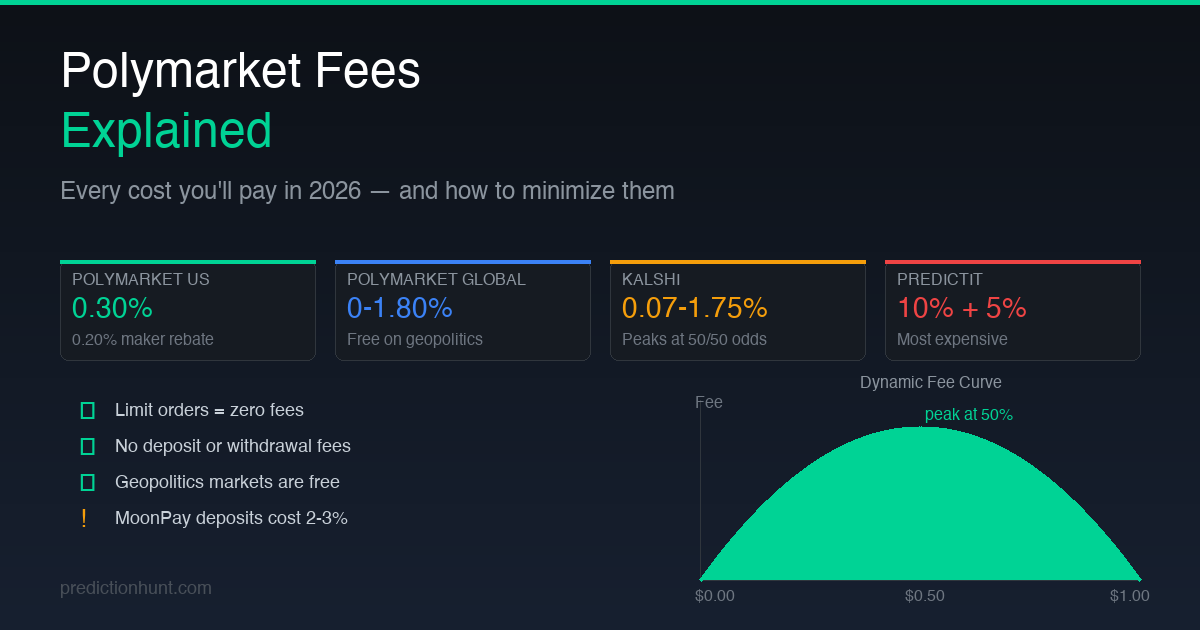
Polymarket Fees 2026: Calculator & Complete Cost Guide
Polymarket promised 1.8% max fees. The actual formula charges up to 7.2% on low-probability crypto markets — here's the math, V1 vs V3 comparison, and how to structure trades to minimize what you pay.
10 min readRead
How to Short on Prediction Markets: The Mechanics Explained
Prediction markets don't have a 'short' button — you express a short view by buying NO or by selling YES shares you own. Here's exactly how it works on Polymarket and Kalshi, with examples.
9 min readRead