
Prediction Market Parlays: How Kalshi Combos Work and Why They Beat Sportsbook Parlays
Kalshi lets you combine multiple event contracts into a single parlay. Here's the math behind combos, when they give you better prices, and when they're a trap.
Sportsbook parlays are one of the most profitable products for the house. Stack three legs together and the effective vig climbs to roughly 13%. On a four-leg parlay, you're often facing 15%+ before a game even starts. Kalshi Combos — the prediction market version of a parlay — work differently. No house sets the odds, and the compounding vig problem disappears. But that doesn't mean the advantage is automatic. Here's when Kalshi parlays actually save you money and when they're a worse deal than they look.
How Kalshi Combos Work
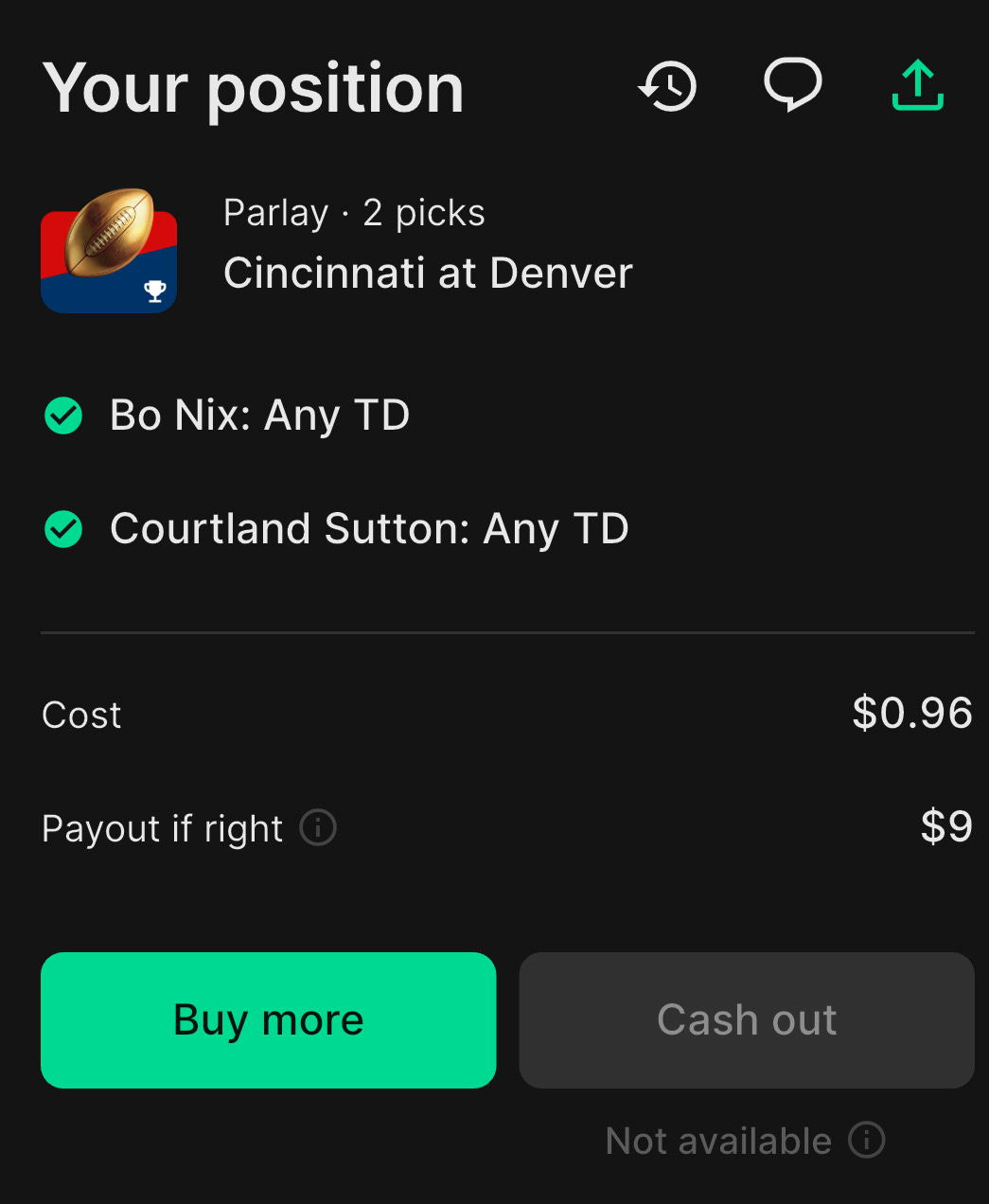
A Kalshi parlay combines multiple event contracts into a single position. All legs must resolve YES for the combo to pay out $1.00 per share. If any leg resolves NO, you get $0.00. Kalshi calls them "Combos" — their version of the parlay familiar to any sports bettor.
Polymarket does not currently offer native parlays. That makes Kalshi the only major prediction market where you can package multiple event contracts into a single trade.
Here's how the mechanics actually work:
- Pick 2+ event contracts you want to combine — sports outcomes, political events, economic indicators, anything on Kalshi.
- Submit the combo as an RFQ (request for quote). This is the key difference from sportsbook parlays and from individual Kalshi contracts. You're not buying from a visible order book — you're requesting a price.
- Institutional market makers price the other side in real time. They evaluate your combo, assess the correlation between legs, and offer you a price. This happens in seconds.
- You see the combo price and decide whether to take it. The price often differs from the mathematical product of individual leg prices — sometimes in your favor, sometimes not.
- If ALL legs resolve YES, you get $1.00 per share. If ANY leg resolves NO, you get $0.00.
You can exit a combo position before resolution by selling it back at the current market price — a major advantage over sportsbook parlays that lock you in until the outcome. Exiting early is possible but depends on liquidity for your specific combo — thinly traded combinations may have wide spreads at exit.
Combos vs. Traditional Sportsbook Parlays
This is the structural comparison that matters most.
| Feature | Sportsbook Parlay | Kalshi Combo |
|---|---|---|
| Who sets the price | The house | Institutional market makers (RFQ) |
| Built-in house edge | Yes — vig compounds per leg | No compounding vig |
| Can sell before resolution | Usually no (or heavily discounted cash out) | Yes — sell at current market price |
| Price transparency | Low (odds set internally) | Medium (RFQ pricing, not open book) |
| Same-game parlays | Yes (huge vig) | Limited availability |
| Edge compounds against you | Yes — 4.5% per leg stacks fast | No — price is a flat market rate |
The structural advantage is real: sportsbook parlays compound the vig across every leg. A 4.5% house edge on one bet is annoying but manageable. Stack that across three legs and the effective edge climbs to ~13%. Four legs: 15%+. That's money you're losing before the games even start.
Kalshi combos don't have this compounding problem. The price is set by a market maker responding to your specific combo, not by a house algorithm inflating each leg's vig.
For more on how prediction market pricing stacks up against traditional books: See our full sportsbooks comparison
The Math: When Combos Save You Money
The governing principle: if you wouldn't bet each leg individually, don't put it in a combo. Combos amplify your edge — but they also amplify your mistakes.
Now, the math that shows when combos are genuinely a better deal.
Example: A good combo (you save money)
- Market A (Lakers win tonight): YES trading at $0.65
- Market B (Celtics win tonight): YES trading at $0.58
- Mathematical product: $0.65 × $0.58 = $0.377
- Kalshi's combo comes back priced at $0.35
You're getting a 2.7-cent discount vs. buying each leg separately. On a $100 position, that's the difference between risking $37.70 and risking $35.00 — a 7% better entry price. Over dozens of trades, that edge compounds. Keep in mind that Kalshi's fee formula applies to each leg — factor those in when calculating whether a combo price is actually cheaper than individual legs. Full fee breakdown here.
Example: A bad combo (you overpay)
- Market C (Bitcoin above $100K Friday): YES at $0.80
- Market D (Fed holds rates in April): YES at $0.72
- Mathematical product: $0.80 × $0.72 = $0.576
- Kalshi's combo comes back priced at $0.60
You're paying a 2.4-cent premium for the packaging. These two events are essentially uncorrelated — Bitcoin's price and the Fed's April decision don't meaningfully influence each other. The mathematical product ($0.576) is already the fair price for independent events. The extra $0.024 per share is the market maker's profit on a combo you didn't need to bundle.
Why discounts exist: Packaging legs together concentrates risk. Market makers sometimes offer better prices on combos to attract volume, especially when the legs are correlated (meaning the combined risk is lower than independent pricing suggests).
Why premiums exist: When events are uncorrelated, the market maker is doing you a convenience favor by packaging them — and charging for it. The spread on a combo also tends to be wider than individual spreads because fewer participants trade the exact combination you want.
What the Research Actually Shows About Combo Returns
Here's the part most articles about Kalshi combos leave out.
Research from University College Dublin found that retail takers on Kalshi's RFQ combo system lose more often than not, with the institutional market makers on the other side earning money consistently. This shouldn't be surprising — it's the same dynamic as options market-making on traditional exchanges. The market maker has better models, faster data, and more capital. They're not offering you a fair coin flip.
This doesn't mean combos are a bad product. It means the structural advantage over sportsbooks (no compounding vig) doesn't automatically translate into a trader advantage. You've eliminated one source of edge erosion (the house vig), but you've introduced another (an institutional counterparty who may price the combo more accurately than you can).
The practical takeaway: combos are worth using when you have genuine conviction on correlated outcomes and the combo price is meaningfully below the mathematical product of individual legs. If you're bundling uncorrelated events or taking combo prices at face value without checking the math, you're likely on the wrong side of the trade.
When to Use Combos (And When Not To)
Use combos when:
- You have a strong thesis on correlated outcomes. "Team A wins AND the over hits" in a game you've deeply researched is a legitimate combo thesis. The correlation between these outcomes means the combo might actually be underpriced relative to individual legs.
- The combo price is meaningfully cheaper than the product of individual legs. Do the multiplication. If the combo saves you 2+ cents per share on a sub-dollar contract, that's a real edge worth capturing.
- You want to express a complex multi-event thesis in a single position with defined risk and the ability to exit before resolution.
Avoid combos when:
- You're combining uncorrelated events just for a bigger payout. "Lakers win AND Bitcoin above $100K by Friday" is not a thesis — it's a lottery ticket. The math is just as punishing here as on a sportsbook.
- The combo spread is worse than buying legs separately. Always check. If you can get better execution trading each leg individually, do that.
- You don't have a specific informational edge on ALL legs. One weak leg torpedoes the entire bet. If you're confident on two legs but guessing on the third, you're diluting your edge with noise.
- You're combining more than 3-4 legs. Each additional leg multiplies your risk and widens the market maker's spread. Beyond four legs, you're almost certainly overpaying.
Using Prediction Hunt for Parlay Research
Before placing any combo, you should know whether you're getting the best price on each component:
- Compare individual leg prices across platforms — check Kalshi and Polymarket side-by-side. If one platform has a leg cheaper, buy it there individually instead of bundling it into a combo at a worse price.
- Calculate the mathematical product — plug in your leg prices and compare to the combo quote. If the combo isn't saving you money, skip it.
- Check for arbitrage on individual legs — sometimes the best move isn't a combo at all. A mispriced individual leg with a clear edge is a better trade than a combo where you're guessing on one component.
The sharper your research on each component, the better your combo decisions. Don't package trades you haven't individually vetted.
Frequently Asked Questions
Does Polymarket have parlays?
Not natively. Polymarket currently only supports individual market trades. Kalshi is the only major prediction market offering built-in combo/parlay functionality. If you want parlay-style exposure on Polymarket, you'd need to trade each leg separately and manage them independently.
Are prediction market parlays better than sportsbook parlays?
Structurally yes — no compounding house vig is a genuine advantage. But Kalshi combos use an RFQ model where institutional market makers price the other side, and research shows retail takers lose more often than not. The advantage is real but not automatic. You need to check the combo price against the mathematical product of individual legs every time, and only take combos that offer a meaningful discount.
How many legs can I add to a Kalshi combo?
Kalshi supports multi-leg combos, but liquidity thins significantly beyond 3-4 legs. The more legs you add, the wider the market maker's spread — and the more the pricing favors the institutional counterparty. Stick to 2-3 legs unless you have a very specific reason to go bigger and have verified the combo pricing is competitive.
Can I sell a combo before all markets resolve?
Yes. Kalshi combos are tradeable positions. You can exit at the current market price at any time before resolution. This is a major advantage over sportsbook parlays, where early cash-out options are either unavailable or offered at a steep discount to fair value.
Are prediction market parlays a good strategy?
It depends entirely on the specific combo pricing. When a combo is cheaper than the mathematical product of individual legs, they're genuinely good value — you're getting a structural discount that doesn't exist at sportsbooks. When the combo spread is wider than individual spreads combined, you're paying extra for packaging you don't need. Always compare the combo price to the product of individual leg prices before placing the bet. And remember: research shows institutional market makers on the other side of these trades win more often than retail takers do.
Prediction market trading involves financial risk. This article is for informational purposes only and is not investment or financial advice.
Build with this data
Automate your strategies, create arb bots, or build your own dashboard. Free tier includes 1,000 requests/mo across all prediction market platforms.
Free Trading Tools
View allCompare fees across Kalshi, Polymarket & PredictIt.
Find fair probabilities with the overround removed.
See if a trade has positive EV before you enter.
Convert American, decimal & implied probability.
Combined odds and payouts for multi-leg bets.
Your real take-home after fees and taxes.
Related Posts

How to Build a Prediction Market Trading Bot: A Practical API Guide
A technical walkthrough of the APIs, SDKs, strategies, and hard-earned lessons behind building automated trading systems for prediction markets — from your first API call to a working bot.
11 min readRead
Position Sizing in Prediction Markets: The Kelly Criterion Guide
The Kelly Criterion, fractional Kelly, correlation risk, and why most prediction market traders blow up not because they're wrong — but because they bet too much when they're right.
13 min readRead
How to Evaluate Prediction Market Liquidity Before You Trade
A practical guide to checking depth, spreads, and fill quality before you commit capital. Stop getting worse prices than you expected.
9 min readRead