
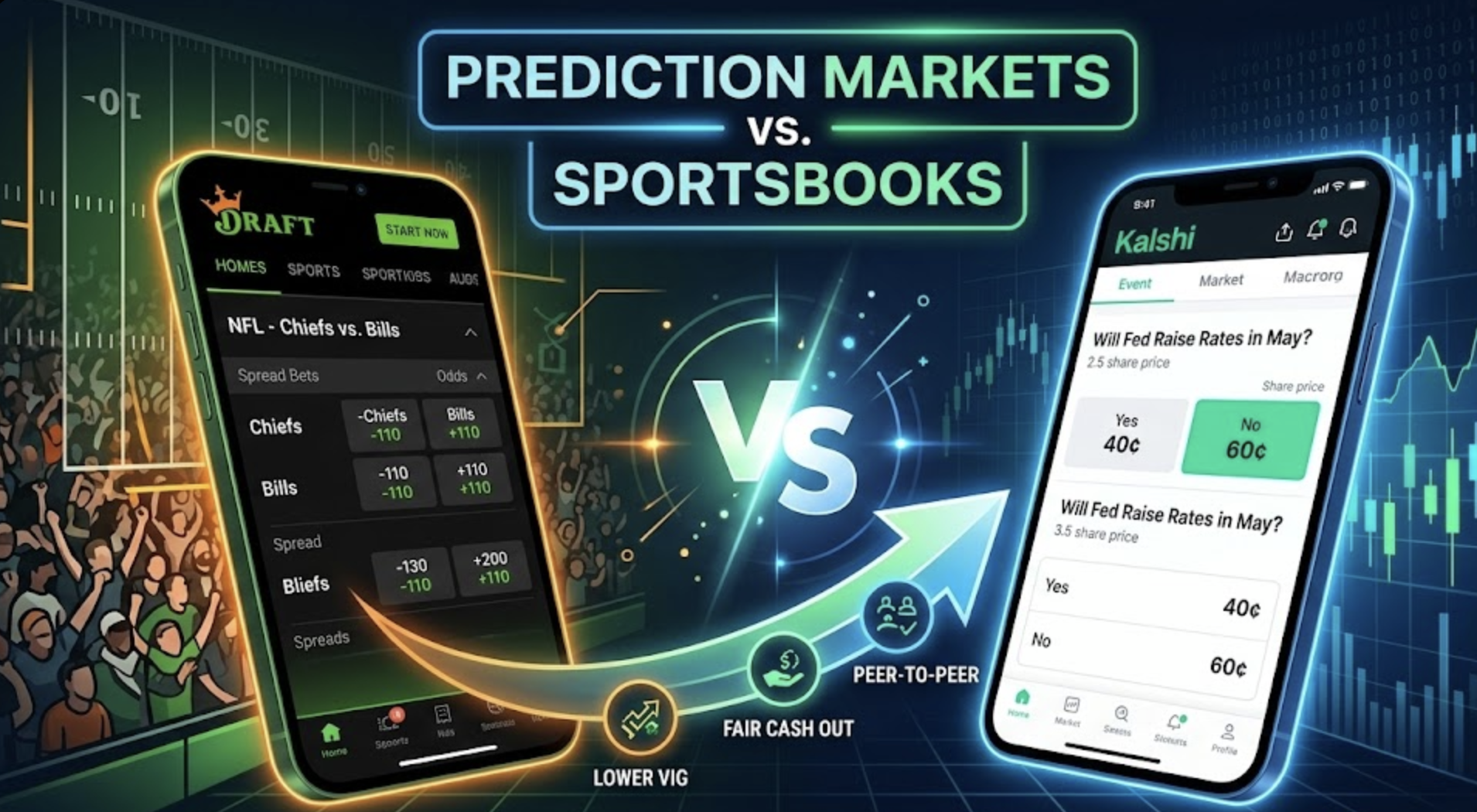
Prediction Markets vs. Sportsbooks: Why Bettors Are Leaving DraftKings for Kalshi
DraftKings charges 4.5% vig on every bet. Kalshi charges 1-2%. Here is why sharp sports bettors are switching to prediction markets in 2026.
If you've spent any time on DraftKings or FanDuel, you already understand edges, lines, and the relentless frustration of watching a sportsbook shade odds against you. You've done the math. You know the house is taking its cut on every single bet, and you've learned to live with it.
But a growing number of experienced sports bettors are waking up to a completely different model — one where the house take is a fraction of what you pay at a traditional book, where you can exit a position mid-event at a fair market price, and where the odds aren't set by a team of traders trying to beat you. Welcome to prediction markets.
Here's what you need to know.
From American Odds to Share Prices: Same Math, Different Language
The first thing that trips up sportsbook bettors moving into prediction markets is the pricing model. But once you see how it maps to what you already know, it clicks instantly.
| American Odds | Implied Probability | Prediction Market Share Price |
|---|---|---|
| +400 | 20% | 20¢ |
| +150 | 40% | 40¢ |
| -110 | 52.4% | 52¢ |
| -200 | 66.7% | 67¢ |
| -400 | 80% | 80¢ |
When DraftKings offers you a team at +150, that means you risk $100 to win $150. That translates to an implied probability of about 40% — the break-even winning percentage at that price.
On Kalshi or Polymarket, that same 40% probability is expressed as 40¢ per share. Buy a "Yes" share at 40¢ and it pays out $1.00 if it resolves correctly — a 150% return on your stake. Lose, and your 40¢ goes to zero.
The math is identical. The only difference is the vocabulary. Once you internalize that every share price is just a probability expressed in cents, reading prediction market odds becomes completely intuitive. A 65¢ contract is a -185 favorite. A 20¢ contract is a +400 longshot.
The Juice Problem — and How Prediction Markets Solve It
Here's the dirty secret of traditional sportsbooks: that -110 line you see on both sides of a spread? It's not a fair coin flip. It's a hidden tax baked into every single bet you place.
Run the math. If you bet $110 to win $100 on both sides of a market, one side wins $100 and the other loses $110. The sportsbook pockets $10 on a $220 action pool — call it what it is: a built-in house edge of about 4.5%. On high-demand markets, that vig climbs to 8%, 10%, or higher. Every bet you place, you're starting in the hole before the game even begins.
| Wager Type | You Bet | You Win | The "House" Edge |
|---|---|---|---|
| DraftKings (-110 Spread) | $110 | $100 | ~4.5% Hidden Tax |
| Kalshi (50¢ Share) | $100 | $100 | 1%–2% Trading Fee |
Prediction markets operate on a fundamentally different model. They are peer-to-peer exchanges: buyers and sellers set the price directly through supply and demand, and the platform charges a small transaction fee — typically 1–2% of winnings — rather than skimming the spread. The market finds its true price based on actual participants, not on a sportsbook risk team trying to manage liability against you.
For a sharp bettor who finds real edges, this is transformative. When you're right, you keep more of what you win.
Cash Out — Actually Fair for Once
Every sports bettor knows the Cash Out feature. It's also one of the most reliably bad deals in sports betting. DraftKings and FanDuel offer cash-out values that discount your position significantly — they're not giving you fair market value, they're extracting another margin from you mid-event.
Prediction markets work differently. Because positions trade on an open exchange, you can sell your shares at whatever the current market price is, at any time before resolution. If you bought a "Yes" at 35¢ and the probability has moved to 62¢ midway through the game, you can sell right now and lock in that gain at the fair market rate. No sportsbook haircut. No algorithm deciding what your position is "worth" to them.
This creates entirely new strategic options: scaling out of a position as odds move in your favor, hedging against a late swing, or simply taking profit rather than riding to resolution. Traders who understand position management from stocks or options will feel right at home.
More Markets, More Niche, More Edge
Traditional sportsbooks focus on what drives volume: NFL point spreads, NBA moneylines, MLB run totals. If you want to bet a Senate race, a Fed rate decision, a tech CEO's tenure, or a macroeconomic indicator — good luck finding a line.
Prediction markets cover all of it. Political events, economic data, tech milestones, geopolitical events, award shows. Some platforms even let you combine multiple outcomes into parlay-style positions, unlocking strategies that sportsbooks reserve for their own profit margin. Because many of these markets are thinner, inefficiencies are common. For sharp bettors willing to do research in less-trafficked markets, the edges are real and available in ways they simply aren't in saturated NFL spreads.
Stop Accepting the Listed Line
On DraftKings, the line is the line. You can shop across sportsbooks, but they're all running similar models with similar margins — and line shopping saves you half a point if you're lucky.
Prediction markets are genuinely dynamic exchanges. The same event can trade at meaningfully different prices on Kalshi vs. Polymarket, especially in the hours after a market opens or when major news drops. A sharp bettor who checks multiple sources before entering a position can routinely find 3–6 cent advantages that compound significantly across hundreds of trades.
Prediction Hunt was built to make that comparison effortless:
- Home Feed: Live market odds across Kalshi and Polymarket in real time — see every major market and where prices diverge across platforms at a glance.
- Trending Feed: The markets with the most volume and movement right now — the prediction market equivalent of the best lines on a Saturday slate.
You've already done the work to become a sharp bettor. The market is bigger than their app. Come find the real price. And if you're ready to place your first prediction market trade, our Polymarket beginner's guide walks you through funding, execution, and exit strategies step by step.
Frequently Asked Questions
What is the vig on DraftKings vs. prediction markets?
DraftKings typically charges a hidden vig of about 4.5% on standard -110 spreads, and it can climb to 8-10% on high-demand markets. Prediction markets like Kalshi charge 1-2% in trading fees, meaning you keep significantly more of your winnings.
Can I cash out a prediction market bet early?
Yes. Unlike sportsbook cash-out features that discount your position, prediction markets let you sell shares on an open exchange at the current market price at any time before resolution. You get fair market value, not a sportsbook-discounted offer.
How do prediction market odds compare to American odds?
A prediction market share price is just implied probability in cents. A 40-cent share equals +150 American odds (40% implied probability). A 67-cent share equals -200 odds (66.7% implied probability). The math is identical — only the notation differs.
Prediction market trading involves financial risk. This article is for informational purposes only and is not investment or financial advice.
Build with this data
Automate your strategies, create arb bots, or build your own dashboard. Free tier includes 1,000 requests/mo across all prediction market platforms.
Free Trading Tools
View allCompare fees across Kalshi, Polymarket & PredictIt.
Find fair probabilities with the overround removed.
See if a trade has positive EV before you enter.
Convert American, decimal & implied probability.
Combined odds and payouts for multi-leg bets.
Your real take-home after fees and taxes.
Related Posts
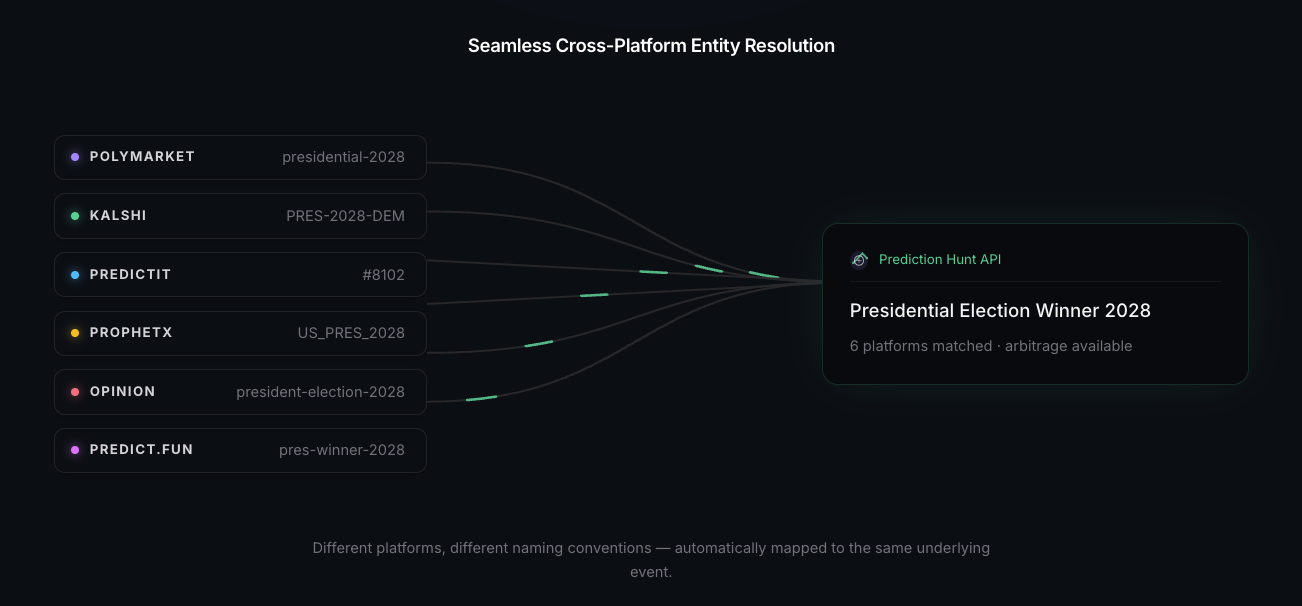
Case Study: Maximizing Alpha in Prediction Markets (Elastics x Prediction Hunt)
How Elastics uses the Prediction Hunt Market Matching API as a smart order router, then layers on agents, arbitrage execution, and plain-English ideation to automate trading across Kalshi, Polymarket, PredictIt and more.
3 min readRead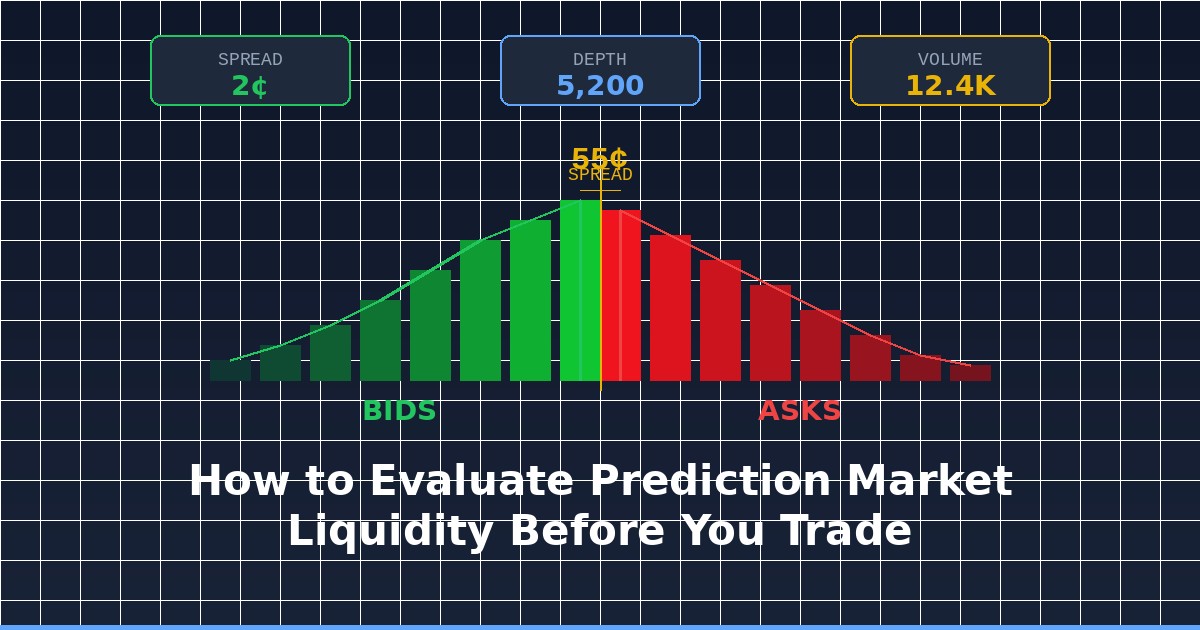
How to Evaluate Prediction Market Liquidity Before You Trade
A practical guide to checking depth, spreads, and fill quality before you commit capital. Stop getting worse prices than you expected.
9 min readRead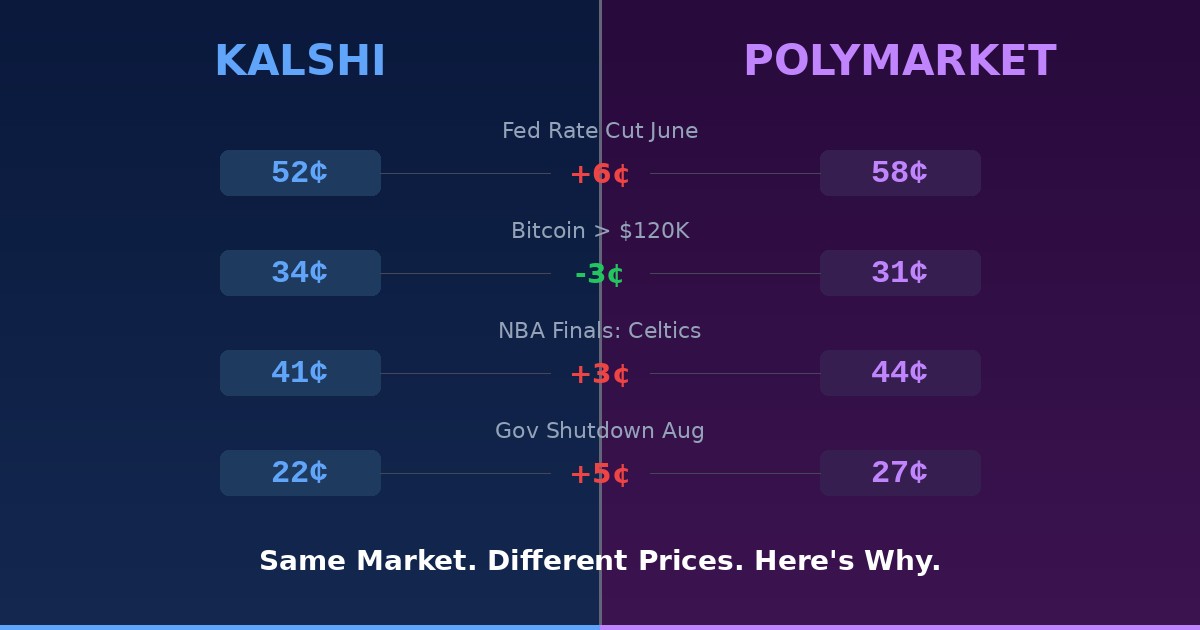
Why the Same Market Has Different Prices on Kalshi vs Polymarket
The same question can trade at 52¢ on one platform and 58¢ on another. It's not a glitch — it's liquidity, demographics, fees, and market structure. Here's what drives the gap.
7 min readRead