
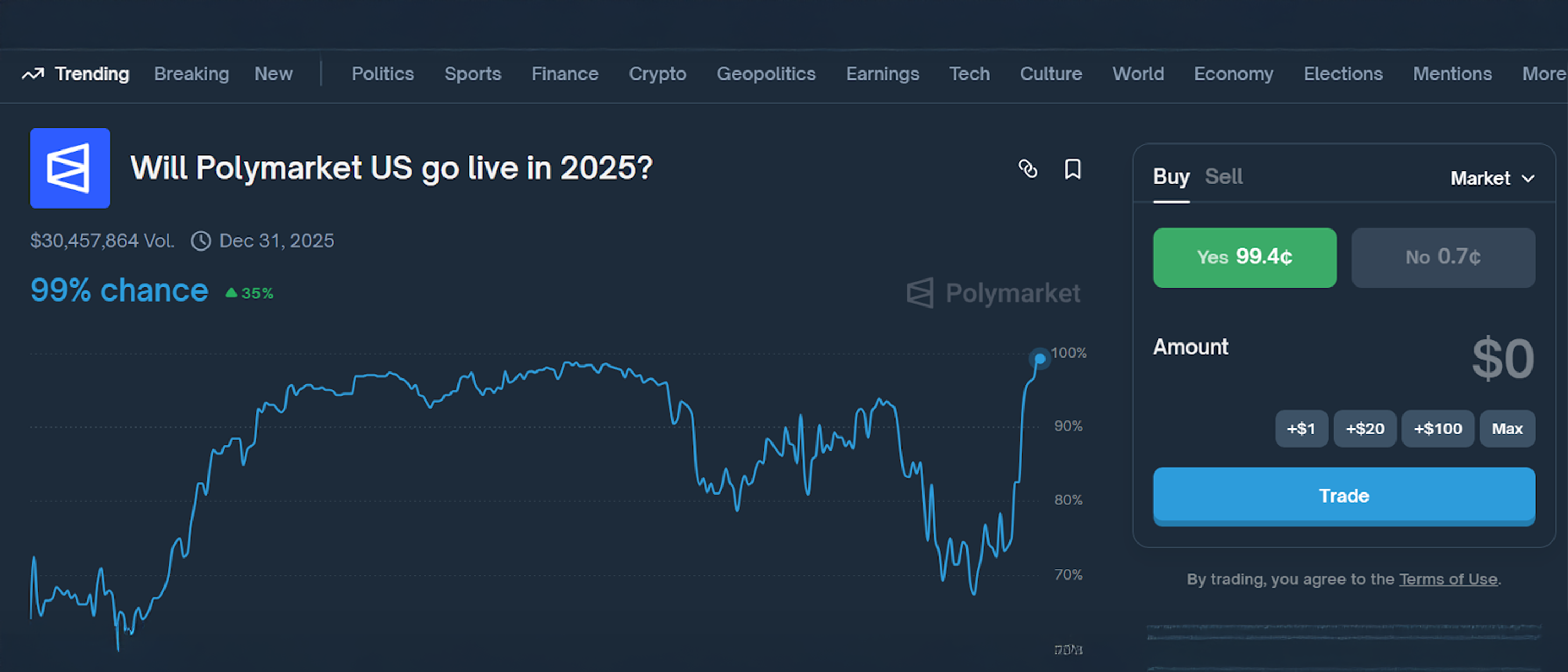
How to Use Polymarket: A Complete Beginner's Guide for US Traders (2026)
Step-by-step Polymarket tutorial for US traders: create your account, deposit funds, place your first trade, and avoid the 5 mistakes that cost beginners money. Updated 2026.
What Is Polymarket?
Polymarket lets you trade YES/NO shares on real-world events — elections, sports, crypto prices, economic outcomes — and get paid $1.00 per share if you're right. It's the world's largest prediction market by volume, and as of late 2025, it's fully legal for US traders.
Share prices range from $0.01 to $0.99, and the price itself represents the market's implied probability that an event will happen. Winning shares pay out $1.00. Losing shares pay $0.00. That's the entire mechanic.
Under the hood, Polymarket runs on the Polygon blockchain and uses USDC, a stablecoin pegged 1:1 to the US dollar. You don't need to understand any of that to use this tutorial — but it's why transaction fees are nearly zero and settlements happen fast.
The big 2025 headline: Polymarket is now available in the United States. After years of being geo-blocked for US users, Polymarket acquired CFTC-licensed exchange QCEX for $112 million in late 2025, bringing the platform under federal regulatory oversight. That deal made Polymarket legal for American traders — no VPN required.
How Polymarket Pricing Works
This is the single most important concept to understand before you place a trade.
A YES share priced at $0.65 means the market collectively believes there's a 65% chance the event happens. A NO share on the same market costs $0.35 — because YES and NO prices always sum to $1.00.
If you buy YES at $0.65 and the event happens, your shares resolve to $1.00. You profit $0.35 per share. If the event doesn't happen, your shares resolve to $0.00 and you lose your $0.65.
The entire game is this: you make money when you're right about something the market is wrong about. If you think an event has an 80% chance of happening but the market prices it at 65%, buying YES gives you an edge. If enough people agree with you, the price rises and you can sell before resolution for a profit — or hold through resolution and collect $1.00 per share.
The flip side works too. If something is priced at 80% and you think the real probability is lower, you buy NO at $0.20 and profit if the event doesn't happen.
Learn more about reading prediction market prices
Setting Up Your Account
Getting started takes about five minutes:
- Go to polymarket.com
- Sign up with email — this creates a smart wallet automatically and is the easiest path for beginners. Alternatively, connect MetaMask if you're a crypto-native user who wants full custody of funds.
- Join the US waitlist — Polymarket's US rollout is happening via invite. Request access and you'll typically get approved within a few days.
- Complete identity verification — required for all US users under CFTC regulations. You'll need a government-issued ID and a selfie. Standard KYC process.
Once verified, you're ready to fund your account and start trading.
Funding Your Account
Two paths depending on your crypto comfort level:
If you're new to crypto (recommended for most beginners):
- Deposit directly with a debit card through Polymarket's MoonPay integration
- Your USD is automatically converted to USDC — you don't need to touch a crypto exchange
- Small fee applies, typically 2-3% of the deposit amount
If you already hold crypto:
- Send USDC on the Polygon network directly to your Polymarket wallet address
- If your USDC is on Ethereum mainnet, you'll need to bridge it to Polygon first (Polymarket walks you through this)
- No deposit fee from Polymarket's side — just minor Polygon gas fees (fractions of a cent)
How much should you start with? We recommend $50-$200. That's enough to spread across 5-10 different markets while you learn the mechanics. Don't put in more than you can afford to lose while you're still figuring things out.
Placing Your First Trade
Let's walk through a concrete example.
Say you find a market: "Will Bitcoin hit $150K by July 2026?" The YES price is $0.32, meaning the market says there's a 32% chance it happens. You've done your research and think it's more likely than that.
You decide to buy 100 YES shares at $0.32. That costs you $32 total.
If Bitcoin hits $150K by the deadline: your shares resolve to $1.00 each. You receive $100 and pocket $68 in profit.
If it doesn't: your shares resolve to $0.00. You lose your $32.
You don't have to hold until resolution. You can sell your shares at any time at the current market price. If the price rises to $0.55 a few weeks later, you could sell your 100 shares for $55 and take the $23 profit without waiting for the outcome.
Order types you need to know:
| Order Type | How It Works | Fee |
|---|---|---|
| Market order | Executes immediately at the best available price | Category-based taker fee (see below) |
| Limit order | You set the price; trade executes when someone takes the other side | Free (maker order) |
A maker order adds liquidity to the market by setting a price and waiting — Polymarket rewards this with zero fees. A taker order removes liquidity by filling an existing order, and pays a category-based fee that varies by market type.
Limit orders are powerful. If you want YES shares but only at $0.30 instead of the current $0.32, place a limit order at $0.30 and wait. If the price dips, your order fills — and you pay zero fees.
Fees
Polymarket recently introduced category-based taker fees. The fee uses a P×(1-P) formula with a multiplier that varies by market category:
| Market Category | Fee Multiplier | Peak Fee (at 50¢) |
|---|---|---|
| Politics | 4.0% | ~1.0% |
| Crypto | 7.2% | ~1.8% |
| Sports | 3.0% | ~0.8% |
| Finance / Culture | 5.0% | ~1.25% |
| Geopolitical | 0% | Exempt |
Maker orders (limit orders) are still free for everyone. This is a huge advantage if you're patient enough to set prices and wait.
Fees are highest on 50/50 contracts and approach zero near the extremes (contracts priced close to $0.01 or $0.99). For most trades, you're paying less than Kalshi — and far less than PredictIt's 10% profit cut. But fees do compound for active traders, especially on crypto markets where the multiplier is highest.
Full fee comparison across all platforms
5 Mistakes New Polymarket Traders Make
These are the errors that cost beginners real money. Every one of them is avoidable.
1. Trading without comparing prices. The same event is frequently listed on Kalshi at a different price than Polymarket. If Polymarket has YES at $0.65 and Kalshi has it at $0.60, you're overpaying by buying on Polymarket. Always check the other side of the street. Compare prices across platforms on Prediction Hunt
2. Ignoring resolution rules. Every market has specific resolution criteria — the exact source, date, and definition that determines the outcome. "Will X happen?" might resolve based on a specific news outlet's reporting, a government publication date, or a narrow technical definition. Read the fine print before you trade. People lose money on technicalities all the time. A market about "the next Fed rate cut" might resolve based on the announcement date, not when the cut takes effect. If you assumed wrong, you're out of luck.
3. Not understanding the tax implications. Every Polymarket trade is a taxable event in the eyes of the IRS. Every buy, every sell, every resolution must be tracked and reported on Form 8949. Polymarket issues no tax documents — you're on your own. Ignoring this doesn't make the obligation disappear; it makes the penalty worse. Read our full tax guide
4. Overconcentrating in one market. Putting $500 into a single 90%-probability market feels safe — until the 10% scenario hits and wipes your entire position. Spread your capital across multiple uncorrelated markets. Diversification isn't just a stock market concept. It's the difference between a bad week and a blown account.
5. Holding through resolution instead of selling at 95 cents or higher. When a market is priced at $0.95+, the outcome is essentially priced in. You're risking $0.95 to make $0.05. Experienced traders sell near resolution to avoid dispute risk, lock in gains, and reinvest that capital into new opportunities with better upside. The last nickel is rarely worth the wait.
Before You Place Any Trade, Check These Three Things
Once you're past the basics, these are the steps that separate beginners from traders who actually keep their profits:
- Compare the price across platforms — see the same event priced on Kalshi and Polymarket side-by-side on Prediction Hunt. If Polymarket has YES at $0.65 and Kalshi has it at $0.60, you want to know that before you buy.
- Check for arbitrage — when two platforms disagree on the same outcome, that price gap is a trade. Our scanner finds these automatically.
- Calculate your actual net payout — fees and taxes can quietly eat your edge. Know what you'll actually keep before you commit capital.
For ongoing research, the Smart Money Feed tracks what high-conviction traders are buying. If sharp money is loading up on one side of a market, you want to know before the price moves.
Is Polymarket Right for You?
Polymarket is best if you: want near-zero trading fees, are comfortable with USDC deposits (or willing to learn), and want access to the deepest liquidity on political, crypto, and global event markets.
Kalshi might be a better fit if you: want a fully bank-integrated US exchange with ACH deposits, prefer no crypto touchpoint at all, or primarily trade sports markets where Kalshi has deeper liquidity.
The best approach for serious traders: use both, and compare prices on Prediction Hunt to trade wherever the price is best.
Frequently Asked Questions
Is Polymarket legal in the US?
Yes. Polymarket acquired CFTC-licensed exchange QCEX in late 2025 for $112 million, bringing US operations under federal regulatory oversight. US access is currently rolling out via an invite waitlist. You no longer need a VPN or offshore workaround to trade legally as an American.
How much money do I need to start on Polymarket?
There's no minimum deposit requirement. We recommend $50-$200 to start — enough to diversify across several markets while keeping risk manageable. You can always add more once you're comfortable with the mechanics.
Do I need crypto experience to use Polymarket?
No. The email signup creates a wallet for you automatically, and you can deposit with a debit card through Polymarket's MoonPay integration. Polymarket handles the blockchain infrastructure behind the scenes. You'll interact with dollar-denominated prices, not crypto complexity.
How do I cash out my Polymarket winnings?
Withdraw USDC to your linked wallet or a crypto exchange (like Coinbase), then convert to USD. If you deposited via debit card, MoonPay supports withdrawals back to your card — typically 3-4 business days. Polymarket itself charges no withdrawal fee; small Polygon network gas fees apply but are negligible.
Do I have to pay taxes on Polymarket?
Yes. Every trade — buying, selling, and contract resolution — is a taxable event. Because Polymarket operates on-chain using USDC, the IRS treats each transaction as a crypto disposal. You're responsible for tracking your own cost basis and proceeds. Polymarket does not issue any tax documents. See our complete tax guide for exactly what to report and which forms to file.
Prediction market trading involves financial risk. This article is for informational purposes only and is not investment or financial advice.
Build with this data
Automate your strategies, create arb bots, or build your own dashboard. Free tier includes 1,000 requests/mo across all prediction market platforms.
Free Trading Tools
View allCompare fees across Kalshi, Polymarket & PredictIt.
Find fair probabilities with the overround removed.
See if a trade has positive EV before you enter.
Convert American, decimal & implied probability.
Combined odds and payouts for multi-leg bets.
Your real take-home after fees and taxes.
Related Posts
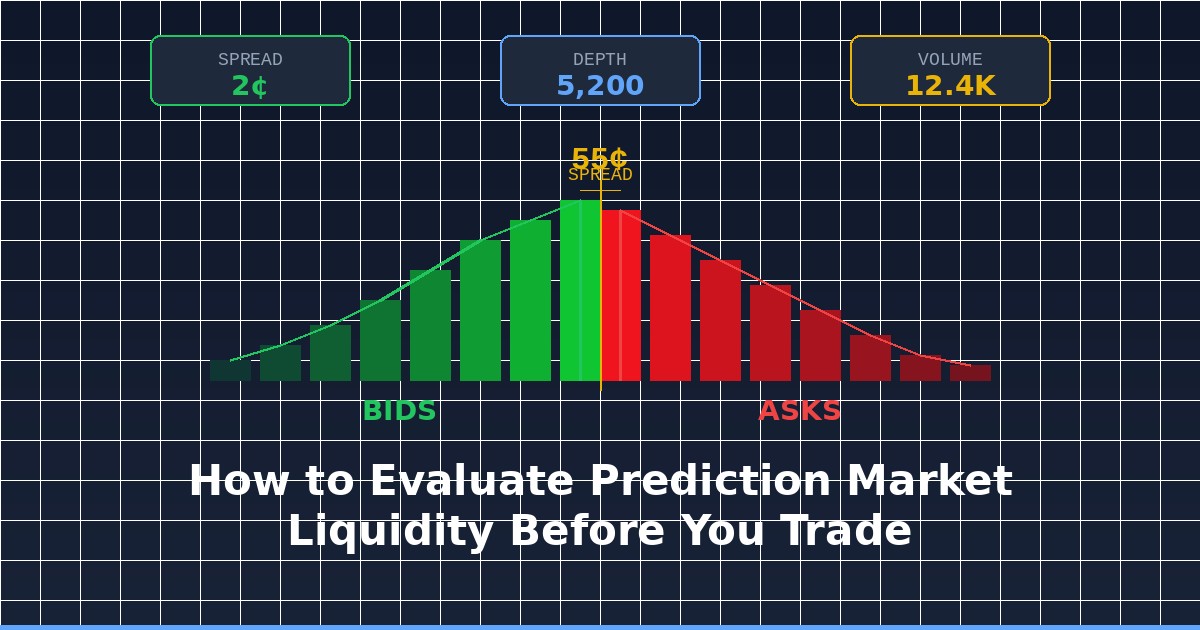
How to Evaluate Prediction Market Liquidity Before You Trade
A practical guide to checking depth, spreads, and fill quality before you commit capital. Stop getting worse prices than you expected.
9 min readRead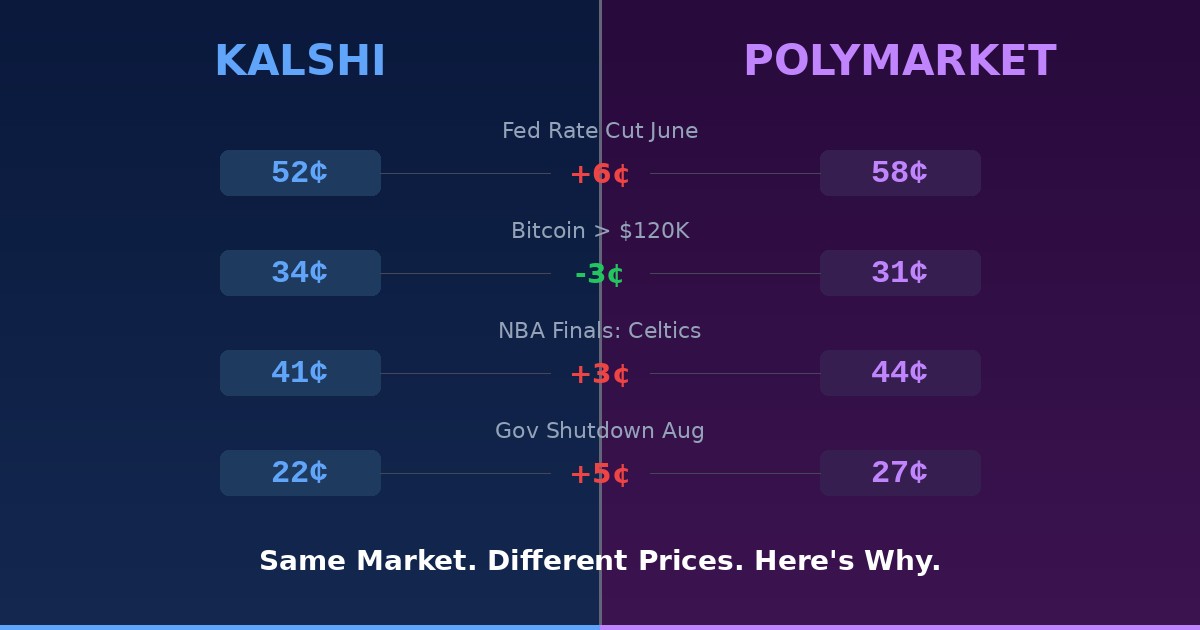
Why the Same Market Has Different Prices on Kalshi vs Polymarket
The same question can trade at 52¢ on one platform and 58¢ on another. It's not a glitch — it's liquidity, demographics, fees, and market structure. Here's what drives the gap.
7 min readRead
How to Build a Prediction Market Trading Bot: A Practical API Guide
A technical walkthrough of the APIs, SDKs, strategies, and hard-earned lessons behind building automated trading systems for prediction markets — from your first API call to a working bot.
11 min readRead