
Do You Owe Taxes on Polymarket Winnings? What the IRS Actually Requires (2026)
Yes — prediction market profits are taxable income. Here's exactly what Polymarket and Kalshi traders owe, what counts as a deductible loss, and how to file without overpaying.
If you traded on Kalshi or Polymarket last year, you already know the hard part: neither platform does your tax homework for you. Every trade, every resolved contract, every USDC settlement — it's on you to report it correctly. Get it wrong and you're understating taxable income on a fully auditable ledger the IRS can pull at any time. Here's what you actually need to know.
Kalshi: Regulated, But Not a Set-It-and-Forget-It
Kalshi is regulated by the Commodity Futures Trading Commission (CFTC) and operates as a registered Designated Contract Market (DCM). That regulatory status matters — but it does not mean Kalshi does your tax homework for you.
A common misconception is that Kalshi issues comprehensive 1099-B forms covering all event contract trading, like a traditional brokerage does for stock trades. This is not currently the case. While Kalshi does issue 1099 documentation for certain specific broker-dealer transactions (such as crypto-related transfers), the platform does not generate a complete 1099-B covering full cost basis and proceeds for your event contract activity. That means Kalshi traders still need to manually track their trade-by-trade cost basis and proceeds throughout the year.
The good news: as a regulated exchange, Kalshi provides account history and trade data exports. The bad news: you still have to organize that data, calculate your gains and losses, and report them accurately — typically on Schedule D of your Form 1040 via Form 8949.
Because Kalshi contracts are regulated futures under CFTC oversight, some traders and tax professionals have explored whether Section 1256 contract treatment applies. Under Section 1256, contracts are marked to market at year-end and taxed under a favorable 60/40 split — 60% long-term capital gains rates, 40% short-term — regardless of how long you held the position. Whether Kalshi event contracts qualify is unsettled — but if they do, the savings are real. A trader in the 32% bracket paying 60% of gains at long-term rates could save thousands compared to ordinary short-term treatment. It's worth asking your CPA about before you file.
Polymarket: The Manual Math Nightmare
Polymarket is a different beast entirely. It operates as a decentralized, offshore prediction market built on the Polygon blockchain. Positions are denominated in USDC, a USD-pegged stablecoin. Polymarket issues no tax documentation whatsoever. You are completely on your own.
Here's where it gets painful: because Polymarket runs on-chain, every single trade is a taxable cryptocurrency event in the eyes of the IRS. When you buy a "Yes" share using USDC, you're disposing of a crypto asset. When you sell or a contract resolves, that's another taxable event. Every entry, exit, and settlement must be logged and reported on Form 8949, which feeds into Schedule D.
To do this correctly, you need:
- A complete export of your Polygon wallet transaction history
- The USD value of USDC at the time of each transaction (for cost basis)
- A method to calculate gain or loss on each individual trade
- Software like Koinly or CoinTracker — or a crypto-savvy CPA — to make sense of it all
If you made dozens or hundreds of trades across multiple markets in 2025, you could be staring at a Form 8949 with hundreds of line items. Miss one and you're potentially understating taxable income. The IRS has been aggressive about crypto reporting, and blockchain transaction data is fully auditable.
The bottom line: both platforms require manual tracking. Kalshi gives you more structured data to work with. Polymarket gives you an on-chain ledger and a headache. If you're still getting set up on Polymarket and want to understand the basics before worrying about taxes, start with our Polymarket beginner's guide.
Emerging Platforms: predict.fun, Probable, and Opinion
Kalshi and Polymarket dominate the volume, but a wave of newer prediction market apps is pulling in traders — and the IRS hasn't issued platform-specific guidance for any of them. That doesn't mean you're off the hook. Your tax obligation depends on the underlying mechanics of how the platform handles money.
The rule of thumb is straightforward once you know what to look for:
On-chain / crypto-rail platforms (predict.fun, Opinion): If a platform settles trades using cryptocurrency or stablecoins on a blockchain, it inherits the same Form 8949 reporting requirements as Polymarket. Every buy, sell, and contract resolution is a taxable crypto disposal. The platform won't send you a 1099 — you need wallet transaction exports and software like Koinly or CoinTracker to reconstruct your cost basis and proceeds. The IRS can audit the on-chain ledger directly, so skipping this is not an option.
Sweepstakes-model platforms (Probable, ProphetX): Platforms that use a sweepstakes or promotional model operate differently. You're typically playing with virtual currency or promo credits, and only cash out when you redeem prizes. Here the key threshold is $600: if you redeem $600 or more in prizes in a calendar year, the platform is required to issue a 1099-MISC. That income gets reported as "Other Income" on Schedule 1 of your Form 1040. Even if you receive less than $600 and no form is issued, the income is still technically taxable — the reporting burden just shifts entirely to you.
The takeaway: before you trade on any new platform, figure out whether it runs on crypto rails or a sweepstakes model. That single distinction determines which IRS forms apply, what records you need to keep, and how painful your April will be.
The "Gambling vs. Capital Gains" Debate — Now With a 2026 Twist
One of the most important — and least settled — tax questions in the prediction market world: are your winnings gambling income or capital gains?
It matters enormously. Here's why.
Gambling income — how the IRS treats sports betting from platforms like DraftKings — is reported as ordinary income on Schedule 1. Losses can be deducted, but only up to your winnings, and only if you itemize deductions. For most Americans who take the standard deduction, that loss offset is functionally worthless.
And starting in 2026, it gets worse. The One Big Beautiful Bill Act (OBBBA), signed into law on July 4, 2025, introduced a new restriction: starting tax year 2026, gambling loss deductions will be capped at 90% of gambling winnings. This does not affect your 2025 return — but if you're planning ahead, it changes the math significantly. Even for itemizers, you will no longer be able to fully offset gambling income with losses. The government is keeping a bigger cut.
Note: the cap has faced significant bipartisan pushback. Three repeal bills have been introduced — the FAIR BET Act, the FULL HOUSE Act, and the WAGER Act — though none have passed as of early 2026.
Short-term capital gains, by contrast, are reported on Schedule D and can still be used to offset capital losses from other investments — stocks, ETFs, crypto, anything. The OBBBA did not change this. That flexibility remains enormously valuable for traders with diversified portfolios.
The current IRS position on prediction markets is ambiguous. No formal guidance specifically classifies event contract trading as gambling. The prevailing approach among tax professionals is to treat prediction market positions as capital assets, meaning gains and losses flow through Schedule D as short-term capital gains for contracts held under a year. This treatment is more favorable than gambling classification — especially now that the OBBBA has tightened the screws.
That said, this is genuinely unsettled law. The IRS could issue guidance at any time that reclassifies these instruments. Work with a professional who follows this space closely.
Why Your Entry Price Is Also a Tax Strategy
All of which makes your entry price more consequential than most traders realize. Here's the angle most traders miss: taxes make your entry price matter even more than it already does.
If you find a contract at 50¢ instead of 55¢, you've increased your pre-tax return by over 9% on a position that resolves at $1.00. After factoring in short-term capital gains taxes — potentially 22%, 24%, or higher depending on your bracket — that extra 5¢ at entry can be the difference between a profitable trade and a break-even one.
This is why sophisticated traders obsessively shop for the best price before entering a position. A 3–5 cent difference isn't a rounding error. It's your margin.
How Prediction Hunt Can Help
At Prediction Hunt, we built tools specifically for traders who think this way.
Smart Money Feed: Track where high-volume traders are entering positions across Kalshi and Polymarket. If the smart money is buying at 38¢ and you're about to pay 43¢, you want to know that before you confirm.
Net Profit Calculator: Since both platforms require manual tracking anyway, use our net profit calculator to estimate your actual take-home on any trade after fees and estimated taxes. Enter your position size, entry price, expected exit price, and tax bracket — and see what you keep, not just what you gross. Net is the only number that matters.
Tax season is brutal enough. Stop leaving money on the table all year.
Frequently Asked Questions
Do I have to pay taxes on Polymarket if I don't cash out to USD?
Because Polymarket operates on-chain without KYC, many traders assume it is tax-free. However, the IRS has strict tracking requirements for USDC transactions. Every trade — buying a share, selling a share, and contract resolution — constitutes a reportable crypto disposal regardless of whether you convert back to USD. Failing to report these on the correct IRS forms can trigger severe penalties. Read our full breakdown of Form 8949 above to see exactly how to log these trades.
Will Kalshi send me a 1099 form?
Kalshi issues 1099 documentation for certain broker-dealer transactions, but does not currently generate a complete 1099-B covering all event contract trades. You are responsible for tracking your own cost basis and proceeds using Kalshi's trade history exports.
Are prediction markets considered gambling by the IRS?
The IRS has not issued formal guidance classifying prediction market trading as gambling. Most tax professionals currently treat event contract positions as capital assets, with gains and losses reported on Schedule D. However, this is unsettled law and could change. Consult a CPA for your specific situation.
What is the 60/40 tax rule for prediction markets?
Section 1256 of the tax code allows certain regulated futures contracts to be taxed at a blended rate — 60% long-term and 40% short-term capital gains — regardless of holding period. Whether Kalshi event contracts qualify is an active area of tax interpretation. Consult a professional before claiming this treatment.
How do I report taxes for predict.fun and Probable?
The tax treatment for newer platforms like predict.fun, Probable, and Opinion depends on whether they use crypto rails or a sweepstakes model. On-chain platforms like predict.fun and Opinion inherit the same Form 8949 reporting requirements as Polymarket — every trade is a taxable crypto event. Sweepstakes-model platforms like Probable and ProphetX may issue a 1099-MISC if you redeem $600 or more in prizes. See our full platform breakdown above for the details that matter at filing time.
Disclaimer: This article is for educational and informational purposes only and does not constitute formal tax, legal, or financial advice. Tax laws are complex and subject to change. Please consult a qualified CPA or tax professional before filing any returns related to prediction market activity.
For further reading on crypto tax reporting, see IRS Publication 544 and the IRS FAQ on virtual currencies. For questions specific to your situation, consult a licensed CPA familiar with digital assets and derivatives.
Build with this data
Automate your strategies, create arb bots, or build your own dashboard. Free tier includes 1,000 requests/mo across all prediction market platforms.
Free Trading Tools
View allCompare fees across Kalshi, Polymarket & PredictIt.
Find fair probabilities with the overround removed.
See if a trade has positive EV before you enter.
Convert American, decimal & implied probability.
Combined odds and payouts for multi-leg bets.
Your real take-home after fees and taxes.
Related Posts
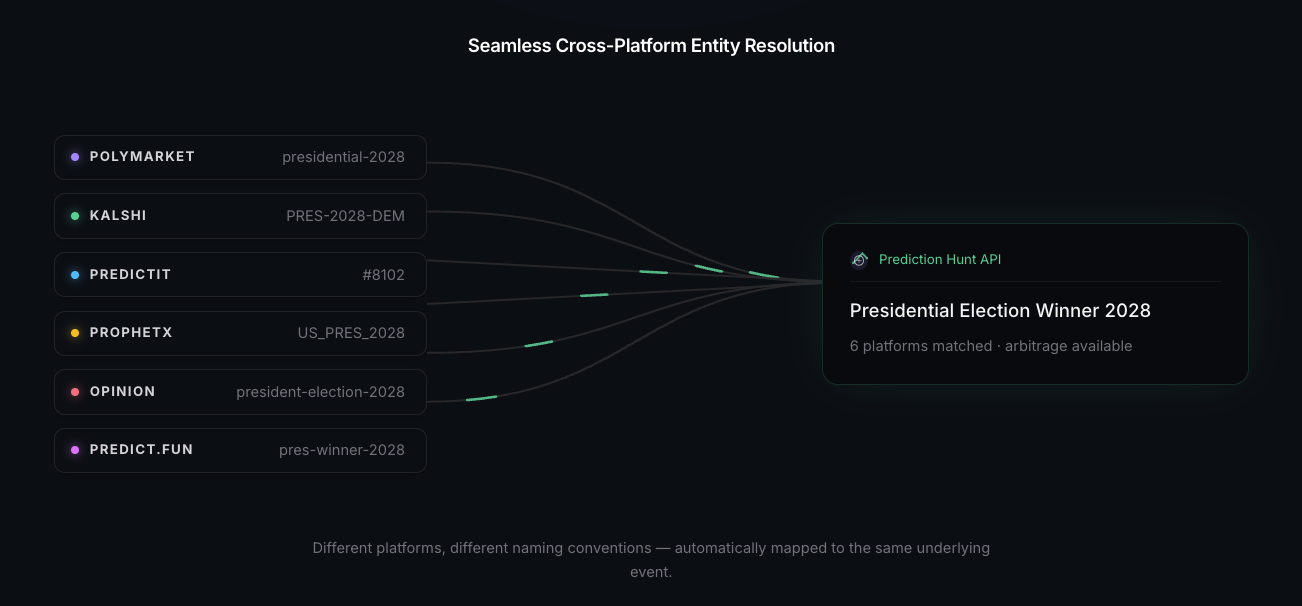
Case Study: Maximizing Alpha in Prediction Markets (Elastics x Prediction Hunt)
How Elastics uses the Prediction Hunt Market Matching API as a smart order router, then layers on agents, arbitrage execution, and plain-English ideation to automate trading across Kalshi, Polymarket, PredictIt and more.
3 min readRead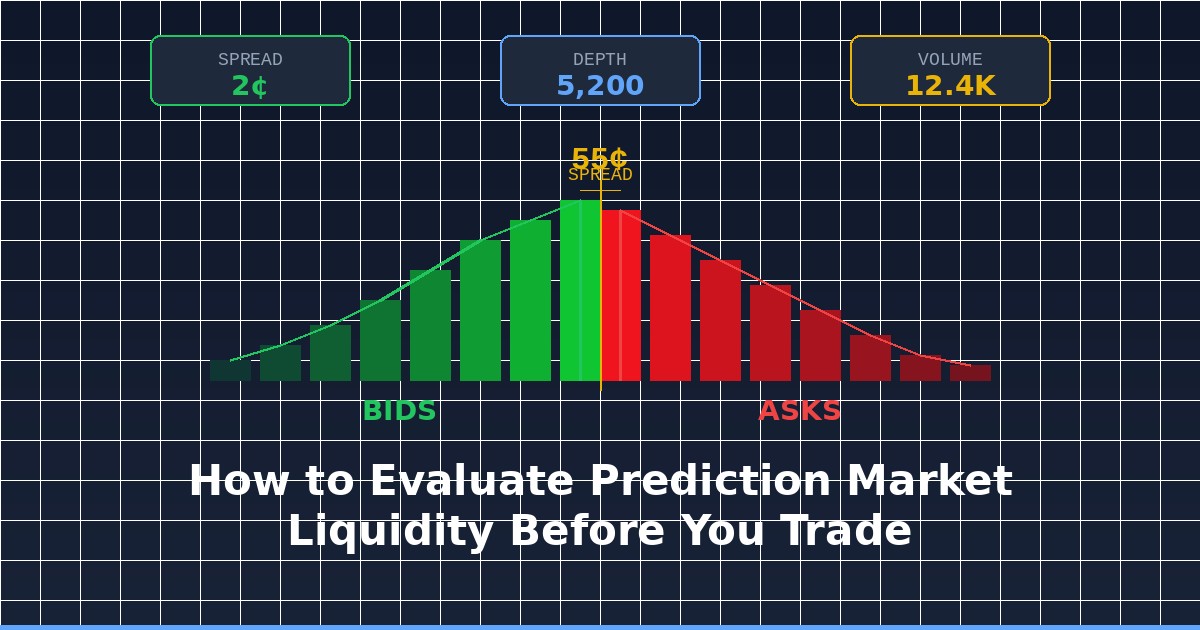
How to Evaluate Prediction Market Liquidity Before You Trade
A practical guide to checking depth, spreads, and fill quality before you commit capital. Stop getting worse prices than you expected.
9 min readRead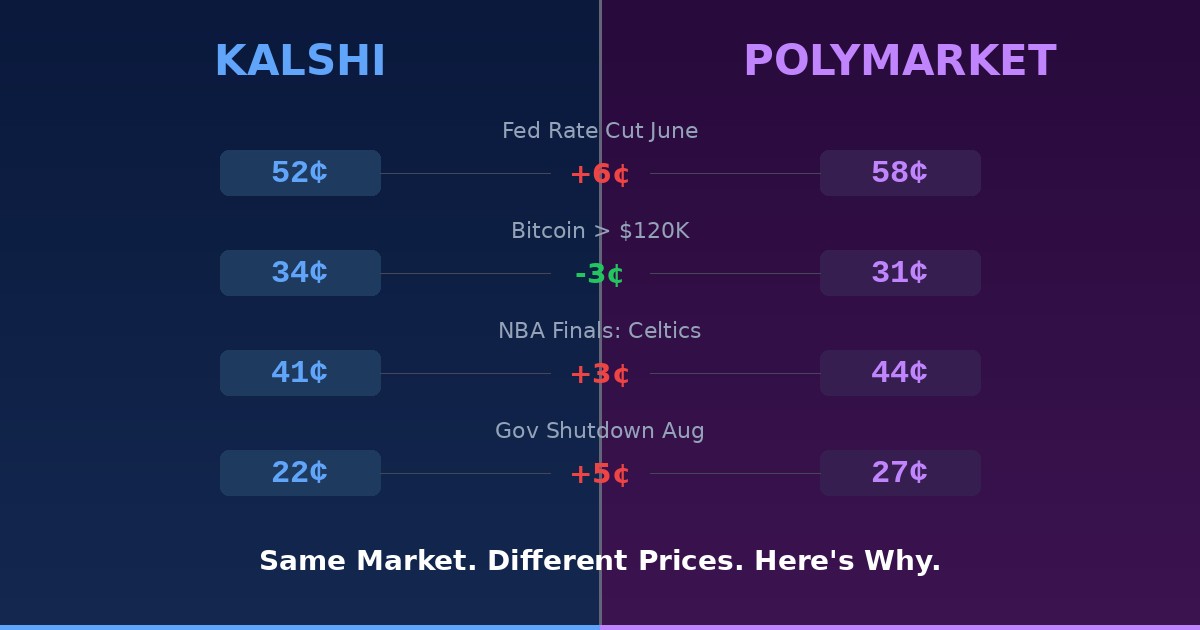
Why the Same Market Has Different Prices on Kalshi vs Polymarket
The same question can trade at 52¢ on one platform and 58¢ on another. It's not a glitch — it's liquidity, demographics, fees, and market structure. Here's what drives the gap.
7 min readRead