

How to Build a Prediction Market Trading Bot: A Practical API Guide
A technical walkthrough of the APIs, SDKs, strategies, and hard-earned lessons behind building automated trading systems for prediction markets — from your first API call to a working bot.
Fourteen of the top twenty most profitable wallets on Polymarket are bots. That statistic — reported by Finance Magnates in early 2026 — should tell you something important about the current state of prediction markets. The edge in this space is increasingly going to participants who can act faster, scan more markets, and execute more consistently than a human sitting at a laptop refreshing browser tabs.
This does not mean you need to build something complex to participate. Some of the most effective prediction market bots are surprisingly simple — a few hundred lines of Python polling an API on a timer. But you do need to understand the infrastructure: what's available, how the pieces connect, and where the sharp edges are.
This is that guide.
The Hard Problem: Cross-Platform Intelligence
Here's a frustrating truth about building a prediction market bot in 2026. There are half a dozen platforms worth monitoring — Kalshi, Polymarket, PredictIt, and more — and each has its own API with different authentication schemes, different data formats, different rate limits, and different endpoint structures. If you want to do anything cross-platform — which is where the most interesting edges live — you're immediately maintaining multiple API integrations, normalizing data across incompatible schemas, and writing contract-matching logic to figure out whether "Will the Fed cut rates by December 2025?" on Kalshi is actually the same thing as a similarly named market on Polymarket.
That integration work is where most bot projects die. Not because the trading logic is hard, but because the plumbing is exhausting.
This is the problem we built the Prediction Hunt API to solve. Our v2 API gives you a single authenticated endpoint to query markets, events, and — critically — matched market groups across platforms. Instead of writing and maintaining separate integrations for every exchange, you use our aggregation layer for discovery and intelligence, then connect to individual platform APIs only when you need to place a trade.
Let me walk you through the full stack: our API for the brain, platform APIs for the hands.
Layer 1: Market Discovery and Cross-Platform Matching (Prediction Hunt API)
The Prediction Hunt API v2 is a REST API authenticated with API keys. Here are the endpoints that matter most for bot building:
Market search and discovery. GET /api/v2/markets returns cursor-paginated markets across all platforms. You can filter by platform, status (active, closed, all), category, and free-text search. One call gives you what would otherwise require querying Kalshi, Polymarket, and PredictIt separately and merging the results yourself.
Event browsing. GET /api/v2/events returns cross-platform events — the real-world occurrences that prediction markets are built around. Filter by event type, tags, date, and status. This is the starting point for any strategy that thinks in terms of events (elections, Fed meetings, sports matchups) rather than individual contracts.
Matched market groups. This is where the real value is. GET /api/v2/matching-markets takes a free-text query, a Polymarket slug, or a Kalshi ticker and returns the canonical group of markets across platforms that resolve to the same underlying outcome. You can also pass a URL directly to GET /api/v2/matching-markets/url — hand it a Polymarket or Kalshi market URL and get back every equivalent contract on every other platform we track, already matched and normalized.
Sports matching. GET /api/v2/matching-markets/sports takes a sport (NBA, NFL, MLB, NHL, CFB, and more) and a date and returns all matched market groups for that day's games across platforms. If you're building a sports arbitrage bot, this single endpoint replaces what would otherwise be a custom pipeline for scraping game schedules, matching team names across different naming conventions, and aligning contract types.
The matching logic behind these endpoints is one of the hardest problems in prediction market aggregation. We use a combination of LLM-based semantic matching and rule-based fallback matching, and we've spent considerable time ensuring that matches are stable — historical match data doesn't get silently invalidated when we improve the algorithm. That stability matters for any bot that's tracking opportunities over time.
Layer 2: Execution (Platform APIs)
Once your bot identifies an opportunity through the Prediction Hunt API, it needs to execute on the underlying platforms. This is where you connect directly to Kalshi and Polymarket.
Kalshi
Kalshi's API lives at trading-api.kalshi.com. Authentication uses RSA-PSS signed API keys — you generate a key pair in your account settings, and each request is signed with your private key along with a timestamp, HTTP method, and path. Session tokens expire every 30 minutes and need automatic refresh.
The core execution endpoints:
GET /markets/{ticker}/orderbook— check depth before you tradePOST /portfolio/orders— place an orderDELETE /portfolio/orders/{order_id}— cancel an order
Kalshi publishes official Python and TypeScript clients that handle RSA-PSS signing automatically. The Python client is maybe 15 lines of code from import to reading a live order book. Kalshi also supports FIX 4.4 protocol for institutional-grade low-latency connectivity — the same protocol used by equity and futures exchanges.
Polymarket
Polymarket's trading API is the CLOB (Central Limit Order Book) at clob.polymarket.com. Despite running on the Polygon blockchain with positions in USDC, it functions like a traditional order book exchange.
Authentication is more involved — a two-layer system. First, your Ethereum private key signs an EIP-712 typed data message to generate API credentials (key, secret, passphrase). Then each request is signed with HMAC-SHA256. Every order placement also requires an individual EIP-712 signature.
The good news: py-clob-client, Polymarket's official Python SDK, abstracts all of this. Install with pip install py-clob-client (500,000+ monthly downloads), initialize with your private key and chain ID 137, and the library handles signing, credential derivation, and order construction internally.
For real-time data, Polymarket's WebSocket streams order book updates and trade execution. Critical detail: you must send a PING every 10 seconds and respond to server PINGs within 10 seconds, or you'll be disconnected. After reconnection, always request a full order book snapshot — incremental updates without a baseline will leave your local state wrong.
Putting It Together: The Two-Layer Architecture
The cleanest architecture for a prediction market bot separates intelligence from execution:
Intelligence layer (Prediction Hunt API). Poll our /api/v2/matching-markets and /api/v2/markets endpoints on a schedule — every 30 seconds to a few minutes depending on your strategy. This is where you scan for cross-platform price discrepancies, discover new markets, and identify matched groups where the same event is priced differently across platforms. Because we handle the normalization and matching, your code stays focused on strategy, not data wrangling.
Execution layer (Platform APIs). When your strategy layer emits a signal, route the order to the correct platform. Your execution module handles authentication, order placement, position tracking, and error handling for each platform independently. Keep this layer thin — it should do exactly what the strategy layer tells it to and nothing more.
Strategy layer (your code). This sits between the two. It consumes matched market data from our API, applies your logic — price comparison, edge estimation, Kelly sizing (see our position sizing guide if you're not already thinking about this) — and emits trade signals to the execution layer. Keeping strategy separate from both data fetching and order execution makes it dramatically easier to backtest, debug, and swap between paper trading and live trading.
Monitoring. At minimum, your bot should notify you (email, Slack, Discord) when: a trade executes, an error occurs, the P&L crosses a threshold, or it loses API connectivity. If you're running an arbitrage strategy, a simple dashboard showing open positions, unrealized P&L, and matched-group pricing across platforms is enormously valuable.
What Bots Actually Do: Five Strategies Worth Understanding
Not all trading bots are created equal. Here are the strategies that dominate prediction market automation, ranked roughly by complexity.
1. Cross-Platform Arbitrage
The most intuitive bot strategy — and the one most naturally suited to the Prediction Hunt API. If Kalshi has a contract at 62 cents YES and Polymarket has the equivalent at 55 cents YES, buying YES on Polymarket and NO on Kalshi locks in a spread — assuming the contracts resolve identically.
The hardest part of cross-platform arbitrage has always been contract matching. "Will the Fed cut rates?" on Kalshi and a similarly named contract on Polymarket may have different resolution criteria, different expiration dates, or different settlement mechanisms. A bot that doesn't account for this will eventually get burned. Our matching-markets endpoint handles the heavy lifting of identifying genuinely equivalent contracts — but you should still read the resolution criteria on both platforms before committing capital. (Our piece on the mirage of free money in cross-exchange arbitrage walks through the failure modes in detail.)
2. Single-Platform Arbitrage
Bots that exploit moments when YES + NO prices on the same contract briefly sum to less than $1.00 have been documented executing thousands of trades with consistent 1.5–3% returns per round trip. The edge is tiny but real, and it requires speed that humans can't match. This strategy doesn't need cross-platform data — it's pure execution speed on a single exchange.
3. Market Making
Market making bots continuously post buy and sell orders on both sides of a market, capturing the spread between them. Post a bid at 58 and an ask at 62, and if both fill, you've captured 4 cents regardless of direction.
This works best in markets with consistent volume and relatively stable prices. It works terribly in markets approaching resolution, where prices move sharply and your stale quotes get picked off by informed traders. Kalshi's API documentation explicitly discusses market making as a use case and offers FIX protocol access for participants who need it.
4. Latency Arbitrage
Some prediction markets — particularly Polymarket's short-duration crypto contracts — derive their fair value from external price feeds. There's a 2–10 second lag between a BTC price move on Binance and its reflection in Polymarket's order book. Latency arbitrage bots exploit this gap, monitoring Binance's WebSocket feed and trading on Polymarket before the market adjusts.
The execution window is tight — delays of 50–100 milliseconds can flip a winning trade into a losing one. This is why some bot operators run code on co-located VPS instances, reducing round-trip times to 1–30 milliseconds. One wallet was reported to have grown from $300 to over $400,000 in a single month on ultra-short-duration crypto contracts. Whether you can replicate that today — with more competition and tighter spreads — is another question.
5. AI-Powered Forecasting
The most ambitious category. These bots use language models, news APIs, and statistical models to form probability estimates, then trade when the market price diverges from their forecast. Several open-source implementations exist, including multi-model ensemble approaches that aggregate forecasts from multiple LLMs. Polymarket released an official open-source agent framework — Polymarket/agents on GitHub — designed for this use case.
The honest assessment: this is the hardest strategy to make work. Your model needs to be better than the market's consensus — which already incorporates the views of thousands of traders, many running their own models. Unless you have a genuine information or analytical edge, an AI-powered bot is likely to be a sophisticated way to lose money slowly.
The Sharp Edges: What Will Bite You
Building the bot is the fun part. Running it in production is where things get real.
Resolution risk is not theoretical. In March 2026, a class action was filed over Polymarket's settlement of a contract about Ayatollah Khamenei, where the question of whether "leaving office" included death generated a genuine dispute. Polymarket uses UMA's optimistic oracle, where resolution can be challenged through a governance vote — and a whale with 25% of UMA voting power can influence the outcome. Your bot might be perfectly right about the real-world event and still lose because of how the resolution mechanism interprets the question.
API downtime happens. When it does, your positions sit unmanaged during potentially the most volatile moments. If your strategy involves offsetting positions across platforms and one API goes down while the other doesn't, you're exposed to one-sided risk. Always build in circuit breakers: if your bot can't reach an API, it should stop trading, not try harder.
Thin order books will eat you. Many prediction markets have less than $5,000 in total depth on each side. A bot that tries to deploy $10,000 into one of these markets will move the price against itself so badly that the theoretical edge vanishes before the order is fully filled. Always check order book depth before sizing — your bot should know the difference between "the price is 60 cents" and "the price is 60 cents for the first $200, then 63 cents for the next $500, then 67 cents after that."
Your own code is the biggest risk. A bug that accidentally places an order at the wrong price, or in the wrong direction, or at 10x the intended size, will teach you a lesson you won't forget. Paper trade first. Then trade with tiny positions. Then, after you've watched the system operate through a full market cycle without surprises, consider scaling up.
Start Small, Think Long
The most common mistake I see in prediction market bot building is premature optimization. Someone reads about latency arbitrage, buys a co-located VPS, and writes a complex system — before they've ever placed a single trade through an API manually.
Start by reading data. Hit our /api/v2/matching-markets endpoint with a few queries. Look at how markets are matched across platforms. See where the price discrepancies are. Run a script that polls every few minutes and logs the results to a file. Do this for a week. Get familiar with how the data moves, how often spreads open and close, and how deep the order books actually are.
Then add paper trading. Calculate what your P&L would have been if you'd executed your strategy, without actually placing any orders. Track this for at least two weeks. Our API even supports paper trading functionality if you want to simulate positions.
Then trade with real money — in small amounts. Fifty dollars per position, maximum. Watch what happens. See if the fills match your expectations. Find out where slippage hurts, where API latency matters, and where your strategy's assumptions break down against reality.
The infrastructure is there. The aggregation layer is built. The platform APIs are well-documented. But the distance between "working bot" and "profitable bot" is large, and the only way to close that gap is by doing the work carefully, with small stakes, over time.
If you're ready to start building, grab an API key and start pulling data. The markets are open.
Build with this data
Automate your strategies, create arb bots, or build your own dashboard. Free tier includes 1,000 requests/mo across all prediction market platforms.
Free Trading Tools
View allCompare fees across Kalshi, Polymarket & PredictIt.
Find fair probabilities with the overround removed.
See if a trade has positive EV before you enter.
Convert American, decimal & implied probability.
Combined odds and payouts for multi-leg bets.
Your real take-home after fees and taxes.
Related Posts

Position Sizing in Prediction Markets: The Kelly Criterion Guide
The Kelly Criterion, fractional Kelly, correlation risk, and why most prediction market traders blow up not because they're wrong — but because they bet too much when they're right.
13 min readRead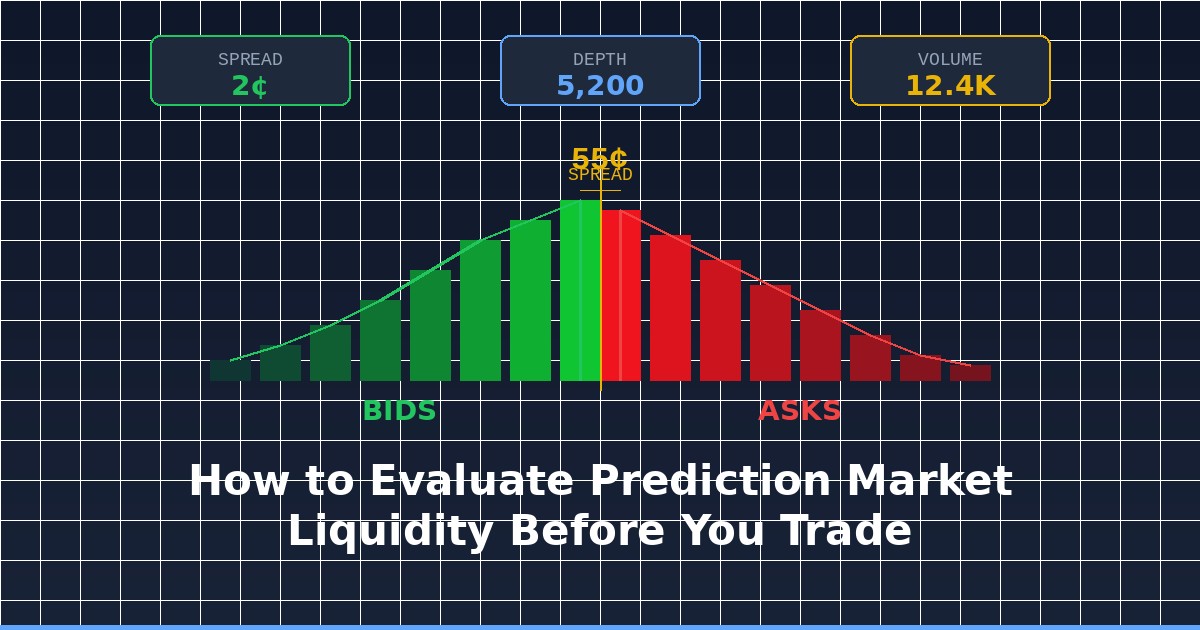
How to Evaluate Prediction Market Liquidity Before You Trade
A practical guide to checking depth, spreads, and fill quality before you commit capital. Stop getting worse prices than you expected.
9 min readRead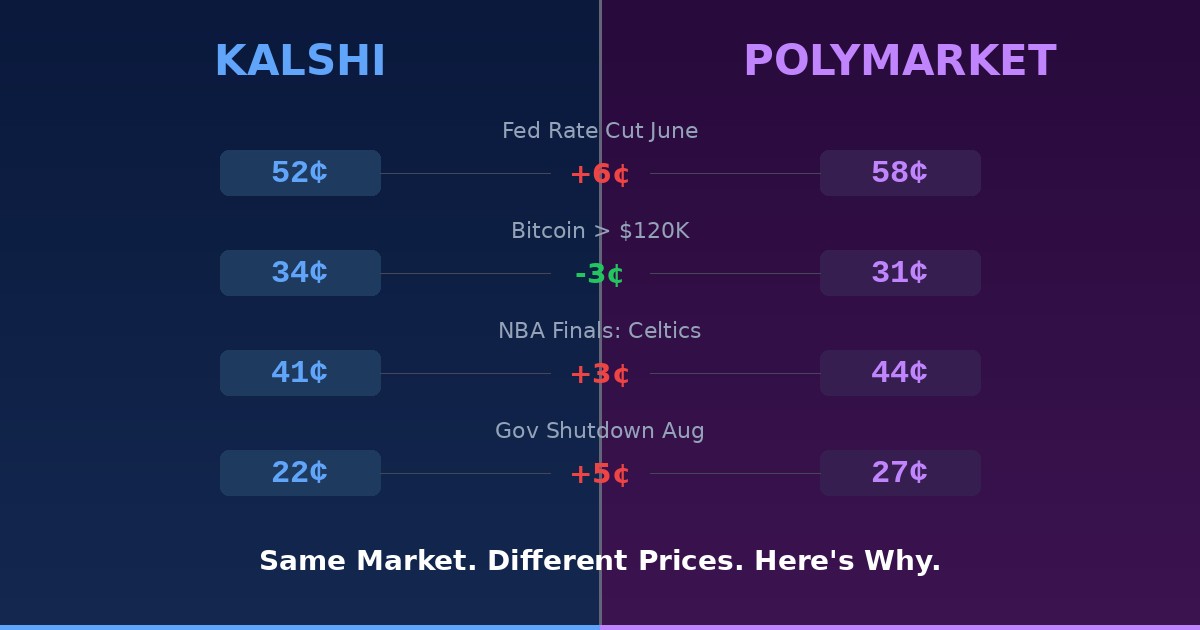
Why the Same Market Has Different Prices on Kalshi vs Polymarket
The same question can trade at 52¢ on one platform and 58¢ on another. It's not a glitch — it's liquidity, demographics, fees, and market structure. Here's what drives the gap.
7 min readRead