

Position Sizing in Prediction Markets: The Kelly Criterion Guide
The Kelly Criterion, fractional Kelly, correlation risk, and why most prediction market traders blow up not because they're wrong — but because they bet too much when they're right.
Eighty-seven percent of Polymarket wallets lose money. That's not a guess — it's what the data shows when you analyze every single trade on Kalshi from 2021 to 2025: 72.1 million trades, $18.26 billion in volume. The losing majority isn't wrong about the world more often than the winning minority. They're wrong about how much to bet.
You find a contract on Kalshi trading at 40 cents that you think should be closer to 55. That's a 15-point edge — huge by any standard. So you buy. The question is: how much?
This is where most prediction market traders go wrong. Not in their analysis, not in their market selection, but in how much they put behind a good idea. The difference between a profitable year and a blown-up account is almost never about being right or wrong on the outcome. It's about sizing. The top 13% who consistently profit aren't better forecasters — they run the math on every position. The other 87% bet on vibes and pay what amounts to an optimism tax on every trade.
And yet, if you go looking for practical guidance on position sizing in prediction markets — real math, not platitudes — you'll find almost nothing. The sports betting world has decades of bankroll management literature. Quantitative finance has entire textbooks on portfolio construction. Prediction markets, which sit awkwardly between the two, have neither.
So let's fix that.
The Kelly Criterion: Elegant in Theory, Dangerous in Practice
The starting point for any serious discussion of bet sizing is John Kelly's 1956 paper at Bell Labs. The Kelly Criterion gives you the fraction of your bankroll that maximizes long-run geometric growth. For a simple binary bet, the formula is:
f* = (bp − q) / b
Where f* is the fraction of your bankroll to wager, b is the net odds (what you win per dollar risked), p is your probability of winning, and q is the probability of losing (1 − p).
In prediction markets, the odds term b has a clean interpretation. If you buy a YES contract at price m, you risk m to win (1 − m). So your net odds are b = (1 − m) / m. A contract at 30 cents gives you b = 0.70/0.30 = 2.33. At 50 cents, b = 1.0. At 80 cents, b = 0.25. The cheaper the contract, the higher the odds — and the more Kelly tells you to bet, if you have edge.
Here's a concrete example broken down step by step:
- Market price: 40¢ (the contract trades at $0.40)
- Your estimated true probability: 55%
- Net odds (b): (1 − 0.40) / 0.40 = 1.5 — you win 60¢ and risk 40¢
- q (loss probability): 1 − 0.55 = 0.45
- Kelly formula: f* = (1.5 × 0.55 − 0.45) / 1.5 = (0.825 − 0.45) / 1.5 = 0.25
- Result: Full Kelly says bet 25% of your bankroll on this trade.
And mathematically, if your probability estimate is perfectly calibrated and you can repeat this exact bet thousands of times, that's the growth-maximizing allocation.
Try it yourself with the calculator below — plug in any contract price and probability estimate to see exactly what Kelly recommends:
Kelly Position Sizing Calculator
Enter your account size, the current contract price, and your estimated probability. The calculator returns the Full, Half, and Quarter Kelly position sizes.
Kelly formula: f* = (b·p − q) / b · For prediction markets: b = (1 − price) / price
There's just one problem: it will also make you miserable.
Why Full Kelly Is a Fantasy
Full Kelly has a well-documented flaw that the formula itself won't warn you about. Research by MacLean, Ziemba, and Blazenko — published in Management Science in 1992 — showed that full Kelly creates a 33% probability of halving your bankroll before doubling it. Read that again. One in three chances you'll watch half your money evaporate before you see any meaningful upside.
For a $10,000 prediction market account, that means a roughly one-in-three chance of staring at $5,000 before you ever see $20,000. Most people — even people who intellectually understand variance — cannot stomach that. They panic, deviate from the strategy, and lock in the drawdown permanently.
This is not a minor inconvenience. It's the core practical failure of full Kelly: it assumes you are a machine that will mechanically execute the same strategy through stomach-churning drawdowns, for months or years, without flinching. You are not that machine.
Fractional Kelly: The Grown-Up Version
The solution practiced by nearly every serious quantitative operation — from Renaissance Technologies to professional sports bettors — is fractional Kelly. Typically half-Kelly or quarter-Kelly.
The tradeoff is remarkably favorable. That same MacLean, Ziemba, and Blazenko research showed that half-Kelly produces approximately 75% of full Kelly's growth rate while cutting volatility in half. You're giving up a quarter of the theoretical upside in exchange for a dramatically smoother ride. For the vast majority of traders, that's an overwhelmingly good deal.
Going back to our example: the contract at 40 cents with a perceived 55% true probability. Full Kelly says 25% of your bankroll. Half-Kelly says 12.5%. Quarter-Kelly says 6.25%.
On a $10,000 account, that's the difference between a $2,500 position, a $1,250 position, and a $625 position — all on the same trade with the same edge. The expected value is positive in all three cases. The difference is entirely about how much pain you're willing to absorb when the inevitable losing streaks arrive.
Most practitioners I'd take seriously land somewhere around half-Kelly as an upper bound, scaling down further when uncertainty about the edge is high. Every serious hedge fund, every professional poker player, and every profitable prediction market bot uses some version of fractional Kelly. The ones who used full Kelly — they're the ones you don't hear about anymore. Survival is the strategy.
The Estimation Problem (Or: You Don't Know What You Think You Know)
Here's the part that should genuinely worry you. The Kelly formula requires one critical input: your probability of winning. And the entire framework's validity depends on that number being accurate.
Think about what you're actually doing when you look at a prediction market contract at 40 cents and say, "I think this should be 55%." You are claiming that the aggregated wisdom of every other trader in the market — people with access to the same information, many of whom do this professionally — is wrong by 15 points. That's a strong claim. Sometimes it's correct. But your confidence interval around that 55% estimate is probably wider than you think.
The data reveals just how treacherous estimation gets at the extremes — and exposes a phenomenon known as the Favorite-Longshot Bias. Contracts priced at 5 cents — which imply a 5% probability — actually win only 4.18% of the time. That's a -16.36% mispricing. Contracts at 1 cent are even worse: they should win 1% of the time, but they win only 0.43%. That's a -57% mispricing. Longshots are systematically overpriced because traders buy them for the same reason people buy lottery tickets — the +1,900% payoff on a 5-cent contract when it hits is psychologically irresistible, even though the expected value is deeply negative. If you're sizing into cheap contracts using a probability estimate that's even slightly too generous, Kelly will have you massively overexposed to positions that are mathematically worse than slot machines.
If your true edge is 5 points instead of 15, the Kelly-optimal bet shrinks dramatically. If your true edge is zero — if the market is right and you're wrong — then any positive position is too large. And here's the insidious part: estimation error compounds. Overestimate your edge by a modest amount and Kelly has you over-betting on every single trade. Do that across dozens of positions and the cumulative drag on your account is brutal.
This is exactly why fractional Kelly exists. It's not a concession to weak nerves. It's insurance against the near-certainty that your probability estimates contain meaningful error. As the saying goes in quantitative finance: estimation error is the enemy of Kelly.
Prediction Markets Have Structural Features That Make Sizing Harder
Position sizing in prediction markets is not the same as position sizing in poker or sports betting, and it's important to understand why.
How you enter matters as much as how much you enter. Analysis of 72 million trades across prediction market platforms uncovered something striking: takers — traders who submit market orders and get filled immediately — lose an average of -1.12% per trade. Makers — traders who place limit orders and wait — gain +1.12% per trade. The difference isn't information. It's patience. A market order says "I want in now, at whatever price." A limit order says "I'll buy at this price and wait." The taker pays the spread. The maker captures it. If you're sizing positions aggressively and using market orders to enter, you're compounding two mistakes: too much capital, deployed at the worst possible price. Discipline in sizing and discipline in execution are the same discipline.
Your capital is locked. When you buy a contract at 40 cents, that 40 cents is tied up until the market resolves — which could be days, weeks, or months. In sports betting, your money is locked for a few hours. In poker, a hand takes minutes. In prediction markets, capital can sit frozen through an entire election cycle. This means the opportunity cost of large positions is enormous. Money parked in a contract at 40 cents can't be deployed elsewhere until resolution.
Liquidity varies wildly. A popular presidential election market might have six figures of depth at every price level. A niche policy contract might have $2,000 total in the order book. Your sizing needs to account for what the market can actually absorb. If you want to put $5,000 into a contract but only $800 is available at the quoted price, you're either going to eat massive slippage or you're going to sit in a partially filled position wondering when the rest will come. The number you see on the screen is not the price you'll pay — it's the price the first few dollars will cost.
Resolution risk is real. Unlike a stock that you can exit at any time, prediction market contracts depend on a specific resolution mechanism. Kalshi uses a CFTC-regulated process. Polymarket uses UMA's optimistic oracle. And these resolution mechanisms can produce outcomes that surprise you — not because the event didn't happen, but because the contract's specific language was interpreted differently than you assumed. The Polymarket Khamenei contract dispute in early 2026, where the question of whether "leaving office" included death, is a vivid example. Sizing into contracts with any ambiguity in resolution criteria should be done with extreme conservatism.
Correlation: The Risk That Doesn't Show Up Until It's Too Late
Suppose you hold five different positions across Kalshi and Polymarket. You feel diversified. But look closer: three of them are politics-adjacent — one on a specific bill passing, one on a cabinet appointment, and one on a broader policy outcome. If the political environment shifts, all three move against you simultaneously.
This is correlation risk, and it is the single most underappreciated danger in prediction market portfolios. Your positions are not independent coin flips. They share underlying drivers. And during the moments of maximum stress — a surprise election result, a sudden policy reversal — correlations spike. The positions you thought were diversified reveal that they were all, in some deep structural sense, the same bet.
The math here is worse than most people realize. If you model the relationship between correlated prediction market positions using standard Gaussian assumptions — the way most people intuitively think about diversification — you'll dramatically underestimate the probability of joint blowups. Quantitative researchers using Student-t copulas (which account for "tail dependence," the tendency for extreme co-movements) find that the probability of all your correlated positions going wrong simultaneously is two to five times higher than Gaussian models suggest. This is exactly the error that brought down portfolio models during the 2008 financial crisis, and it applies with equal force to a prediction market portfolio loaded with politically correlated contracts.
During the 2024 U.S. presidential election, the Wall Street Journal reported that much of the dramatic movement on Polymarket was driven by a small number of traders with roughly $30 million in concentrated positions. These weren't diversified portfolios. They were massive, correlated directional bets on a single outcome. When the outcome went their way, they made fortunes. If it hadn't, the drawdown would have been catastrophic — and not just on one contract, but across every correlated position simultaneously. The traders who got this right — the ones who built durable accounts — did the opposite. The bot known as "RN" on Polymarket accumulated over $6 million in profit trading sports markets. The account "Distinct-baguette" grew $560 into $812,000 market-making crypto UP/DOWN contracts. Neither did it by making enormous concentrated bets on a single outcome. They did it by sizing correctly, thousands of times, with mathematical discipline.
The practical takeaway: before sizing any new position, ask yourself what else in your portfolio moves in the same direction if this trade loses. If the answer is "a lot," your real position is much larger than any individual contract suggests. A useful rule from production Kelly systems: when a new trade is correlated with existing positions, cut the Kelly-recommended size in half. The math supports this — and your survival depends on it.
A Simple Framework That Actually Works
Here's what I'd recommend for anyone taking prediction market trading seriously enough to care about long-term capital growth:
Start with your total bankroll. This is money you can afford to lose entirely without it affecting your life. If losing it would cause genuine financial stress, it's too much.
Cap any single position at 2–5% of bankroll. This is roughly quarter-Kelly to half-Kelly for a typical prediction market edge. If your edge estimate is uncertain — and it almost always is — err toward 2%.
Maintain a 30% cash reserve. Capital that's sitting in your account, undeployed, is not wasted. It's optionality. Markets produce their best opportunities during moments of volatility, and you need dry powder to exploit them. The trader who is fully invested when a mispricing appears has the right analysis and no ability to act on it.
Track your correlated exposure. Group your positions by underlying driver. If more than 15–20% of your portfolio would move in the same direction based on one event or outcome, you're concentrated — even if the positions are on different platforms and in different contracts.
Scale down when you're losing. A simple rule: if your bankroll drops 20% from its peak, cut position sizes in half until you recover. If it drops 40%, stop trading entirely and reassess. This is not about emotions. It's about the math — a 50% drawdown requires a 100% gain just to get back to even. Preventing deep drawdowns is worth more than capturing marginal edge.
Summary: The Prediction Market Sizing Rulebook
Three rules that separate the 13% who profit from the 87% who don't:
Rule 1: Never use Full Kelly. The theoretical optimum will also, one time in three, cut your bankroll in half before it doubles. Half-Kelly delivers 75% of the growth at 50% of the volatility. That tradeoff is nearly always worth taking, especially when your edge estimate has any uncertainty at all — which it always does.
Rule 2: Beware the Longshot. The Favorite-Longshot Bias is real and well-documented. Contracts priced below 10 cents win less often than their price implies. If your strategy involves buying cheap lottery-ticket contracts, you're likely overestimating your edge on every single one. Use the Kelly Calculator above before sizing any position at an extreme probability.
Rule 3: Be a maker, not a taker. Takers lose -1.12% per trade on average. Makers gain +1.12%. Position sizing is only half the edge equation — how you enter matters as much as how much. Limit orders capture the spread instead of paying it. The traders who built durable accounts did both: they sized conservatively and they were patient about entry.
Ready to put this into practice? Browse live arbitrage opportunities on Prediction Hunt →
The Mindset Shift
The hardest part about proper position sizing is that it feels wrong. When you find a trade with real edge, every instinct tells you to go big. The contract is mispriced. You've done the work. You know you're right. Loss aversion — the well-documented tendency for losses to feel roughly twice as painful as equivalent gains feel good — doesn't just apply to losing trades. It also makes you oversize winning ideas, because the psychological reward of a big win feels like it justifies the risk. It doesn't.
But the history of trading — prediction markets, sports betting, financial markets — is littered with people who were right about the outcome and still lost money because they sized the position incorrectly. Being right is necessary. It is not sufficient.
The Kelly Criterion was designed to answer a very specific question: given a known edge, how do you grow your capital as fast as possible without going broke? The answer it gives — a precise, calculated fraction of your wealth — is profoundly unsexy. It tells you to bet less than you want to, always. It tells you that even with a huge edge, putting 50% of your account into one trade is insane. It tells you that the path to long-term wealth is paved with individually modest bets, repeated consistently, with discipline that most people do not have.
The 72-million-trade dataset tells the same story from a different angle. The average taker loses -1.12% per trade. The average maker gains +1.12%. The top 13% aren't luckier or smarter about outcomes — they're disciplined about sizing, patient about entry, and methodical about updating their estimates as new information arrives. The 87% who lose are buying lottery tickets at prices worse than a Vegas slot machine, sizing on gut feeling, and wondering why the math doesn't work out.
That's the real edge in prediction markets. Not finding mispriced contracts — although that matters. The real edge is having the discipline to size correctly when you find them.
Build with this data
Automate your strategies, create arb bots, or build your own dashboard. Free tier includes 1,000 requests/mo across all prediction market platforms.
Free Trading Tools
View allCompare fees across Kalshi, Polymarket & PredictIt.
Find fair probabilities with the overround removed.
See if a trade has positive EV before you enter.
Convert American, decimal & implied probability.
Combined odds and payouts for multi-leg bets.
Your real take-home after fees and taxes.
Related Posts

How to Build a Prediction Market Trading Bot: A Practical API Guide
A technical walkthrough of the APIs, SDKs, strategies, and hard-earned lessons behind building automated trading systems for prediction markets — from your first API call to a working bot.
11 min readRead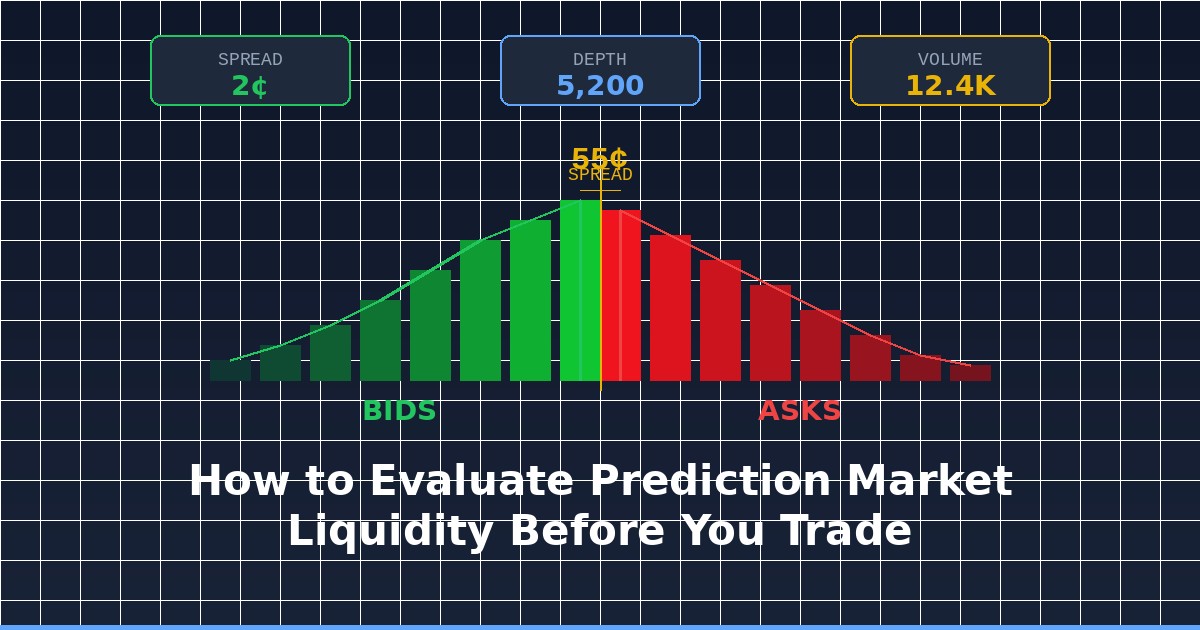
How to Evaluate Prediction Market Liquidity Before You Trade
A practical guide to checking depth, spreads, and fill quality before you commit capital. Stop getting worse prices than you expected.
9 min readRead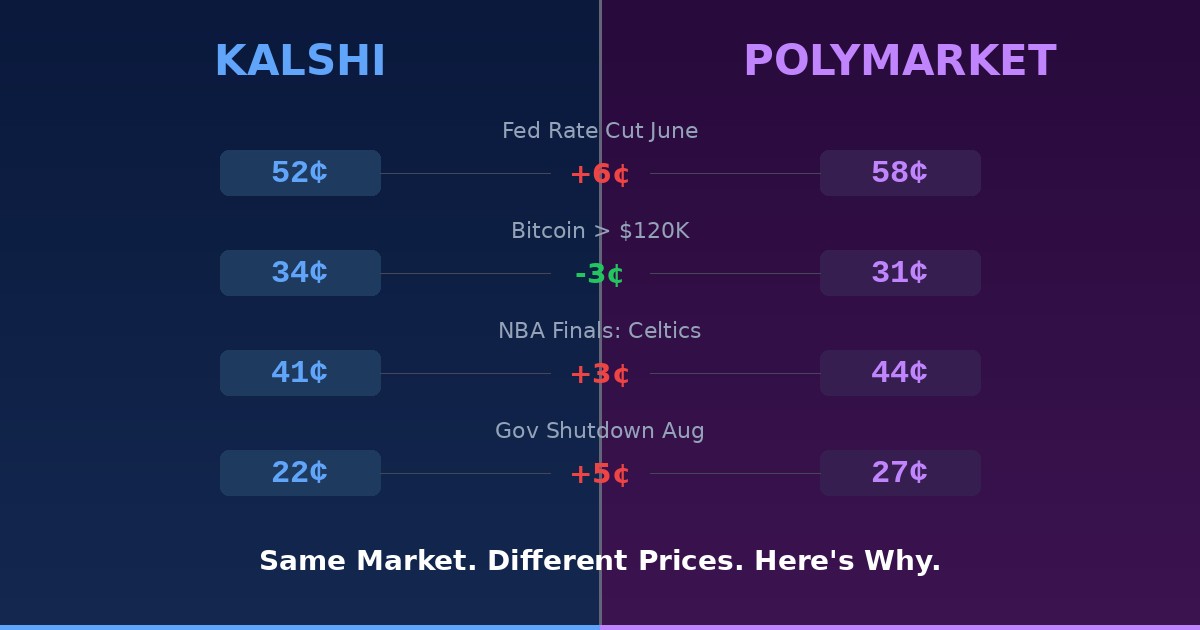
Why the Same Market Has Different Prices on Kalshi vs Polymarket
The same question can trade at 52¢ on one platform and 58¢ on another. It's not a glitch — it's liquidity, demographics, fees, and market structure. Here's what drives the gap.
7 min readRead