

Alt Receiving Yards: What It Means and How to Use It
A practical guide to alternate receiving yards: how they work, risks, and strategies.
In today's sports-betting landscape, player props are more than just headline bets like "Will a receiver score a touchdown?" One of the more nuanced options is the player yardage total, particularly alt receiving yards — and understanding this concept can open up value opportunities for savvy bettors. In this article we'll dive into what alt receiving yards are, how they work, the risks involved, and strategies to put them to use.
What Are Alt Receiving Yards?
At its core, alternate receiving yards (sometimes abbreviated "alt receiving yards") refer to player prop bets on a receiver's total receiving yards in a game, but with alternate lines rather than the sportsbook's standard number. As explained by one betting-education site:
"Alt receiving yards... entail betting on a different set of total receiving yards than the one listed by the sportsbook as the main line. You could bet on a greater number than what they have listed... or you could bet on a lesser number than they have listed, for likelier odds and a lower payout."
In other words: if the sportsbook sets the main line at, say, 73.5 receiving yards for a wide receiver in a given matchup, you might see alternate lines such as 52.5 yards (easier to hit, shorter odds) or 98.5 or even 111.5 yards (harder to hit, longer odds).
So in essence: you have more flexibility compared to just taking the standard receiving yardage over or under. That flexibility allows you to align the bet with your own expectations (more conservative or more aggressive), and thus potentially extract value.
How Alt Receiving Yards Work
- A sportsbook lists a "main line" for a receiver's total receiving yards — e.g., over/under 73.5 yards.
- Alternate lines are then posted: these can be higher (e.g., over 98.5 yards) or lower (e.g., over 52.5 yards).
- Each alternate line comes with its own odds, reflecting the increased or decreased difficulty of the threshold. For instance:
- Over 52.5 yards might have short odds (because it's easier to hit).
- Over 111.5 yards might have significantly longer odds (since it's much less likely).
- Your decision then becomes: Do I believe this receiver will exceed the main line, or do I believe the main line is too liberal/too strict? Based on that, you choose an alternate that aligns with your research and desired risk level.
Why Use Alt Receiving Yards?
Why should a bettor consider these alternate lines rather than just the standard over/under? Several reasons:
- Control over risk and reward: If you believe a receiver is likely to get 60 yards but not 80, you might take a conservative alternate (say 52.5) for lower payout but higher hit-probability. If you believe he'll have a monster game, you could target 100+ yards with longer odds.
- Match your research more precisely: Suppose you analyze matchup, defensive strength, target share, game plan and you believe a particular receiver will have an above-average day. Alternate lines let you reflect that view more granularly (e.g., going for 99+ rather than accepting the standard 73.5).
- Strategic flexibility: The availability of multiple lines means you can use them in parlays, hedge differently, or exploit value when you believe the market is off. For instance, you might anchor a same-game parlay with a conservative alt (lower threshold) and then pair with riskier legs.
Key Risks to Consider
Of course, with flexibility comes risk. Alt receiving yards are not a silver bullet.
- Lower probabilities = longer odds: If you target a high alternate line (e.g. 112+ yards), the payout might be tempting but the likelihood is correspondingly much lower. The bookmaker typically still holds the pricing edge.
- Overconfidence danger: Strong averages or favorable matchups don't guarantee a jump to an alternate high threshold — game conditions, luck, and defensive adjustments all matter.
- Availability issues: Not every sportsbook will offer robust alternate receiving yard lines across all games and players. The more obscure the player or matchup, the fewer options you might have.
- House edge and vig: Sportsbooks still price these lines to win over the long run. Alt lines often carry higher vig than typical lines.
- Live betting volatility: In live markets, receiving yards can shift quickly depending on game flow, injuries, or role changes — your alt line may become misaligned mid-game.
Smart Strategies for Using Alt Receiving Yards
- Study target share and usage — a receiver's role (targets, air yards) is foundational. If he's getting 8-10 targets per game and facing a weak secondary, there might be upside.
- Check defensive opponent metrics — does the defense allow high receiving yardage to that position? Are they vulnerable to deep passes or YAC?
- Game context matters — think about script. Will the team be trailing (more passing)? How do weather and injuries affect volume?
- Line shop for best value — books differ on alt thresholds and prices. Shopping around matters.
- Hedge and mix lines — if your view is moderate, consider conservative alts (e.g., 60+) instead of the main 75+. Confident? Go 95+ or 100+ for higher risk/reward. You can even split stake across two alts.
- Monitor live betting shifts — if early targets spike, you can step up to a higher alternate or hedge. If usage drops, reconsider.
Final Thoughts
In the increasingly sophisticated world of sports betting, alt receiving yards serve as a powerful tool for bettors who want to go beyond mainstream lines. They offer flexibility, let you align wagers with research and game view, and can enhance your strategy if used intelligently. But flexibility doesn't remove risk — higher thresholds come with lower hit rates, and sportsbooks still design pricing to their advantage.
If you're ready to incorporate alt receiving yards into your toolkit, focus on pre-game homework: usage, matchup, script, and conditions. Shop your lines, choose alt thresholds that match your conviction, and remain disciplined. Over time, this can transform a "take the main line or pass" approach into something more calibrated — and potentially more profitable.
Remember: always gamble responsibly and treat these as strategic opportunities rather than sure bets.
Build with this data
Automate your strategies, create arb bots, or build your own dashboard. Free tier includes 1,000 requests/mo across all prediction market platforms.
Free Trading Tools
View allCompare fees across Kalshi, Polymarket & PredictIt.
Find fair probabilities with the overround removed.
See if a trade has positive EV before you enter.
Convert American, decimal & implied probability.
Combined odds and payouts for multi-leg bets.
Your real take-home after fees and taxes.
Related Posts

What Is Reverse Line Movement in Online Betting?
Reverse line movement (RLM) explained: why lines move against public betting, how to spot it early, and when to use it.
7 min readRead
Prediction Market Parlays: How Kalshi Combos Work and Why They Beat Sportsbook Parlays
Kalshi lets you combine multiple event contracts into a single parlay. Here's the math behind combos, when they give you better prices, and when they're a trap.
8 min readRead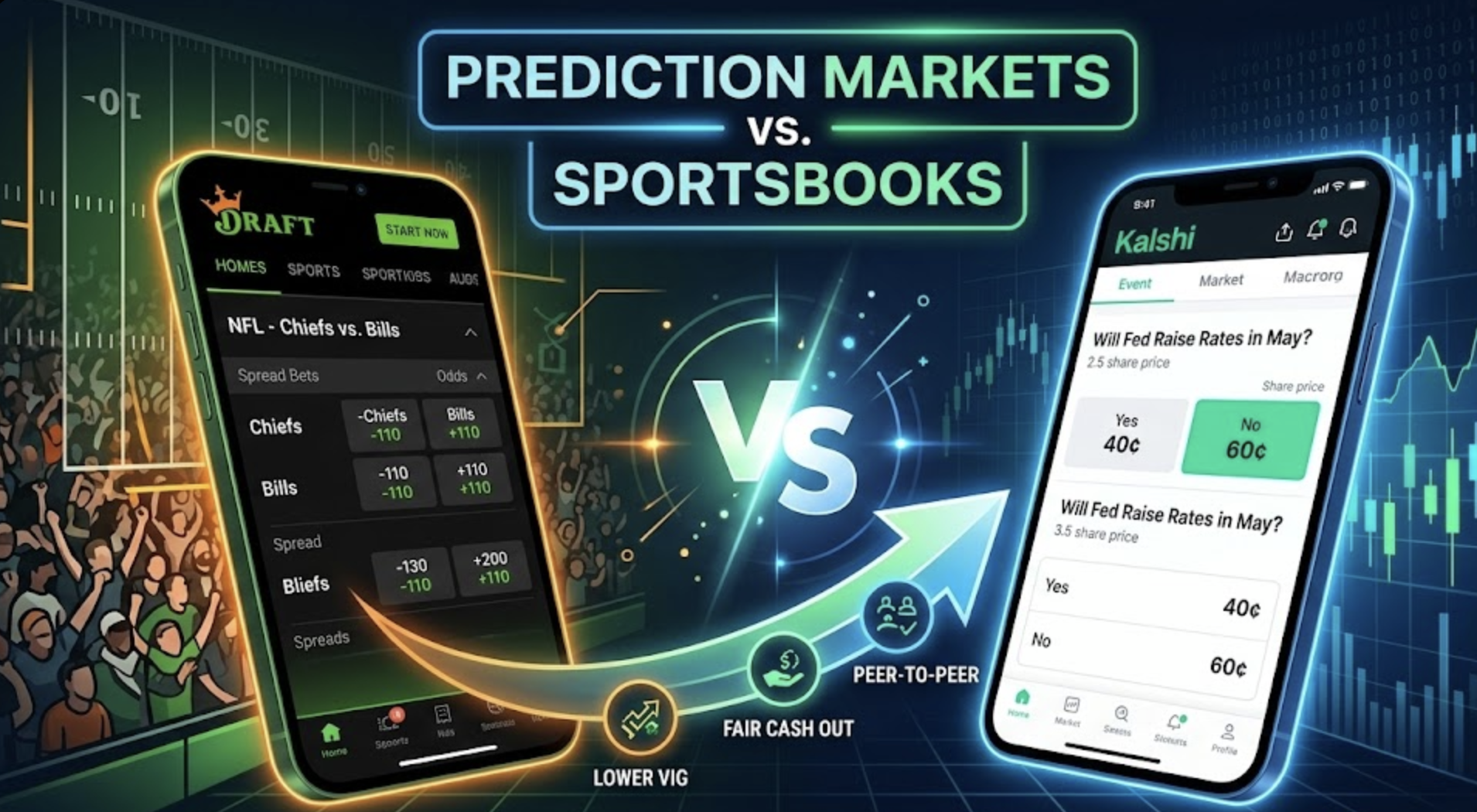
Prediction Markets vs. Sportsbooks: Why Bettors Are Leaving DraftKings for Kalshi
DraftKings charges 4.5% vig on every bet. Kalshi charges 1-2%. Here is why sharp sports bettors are switching to prediction markets in 2026.
6 min readRead