
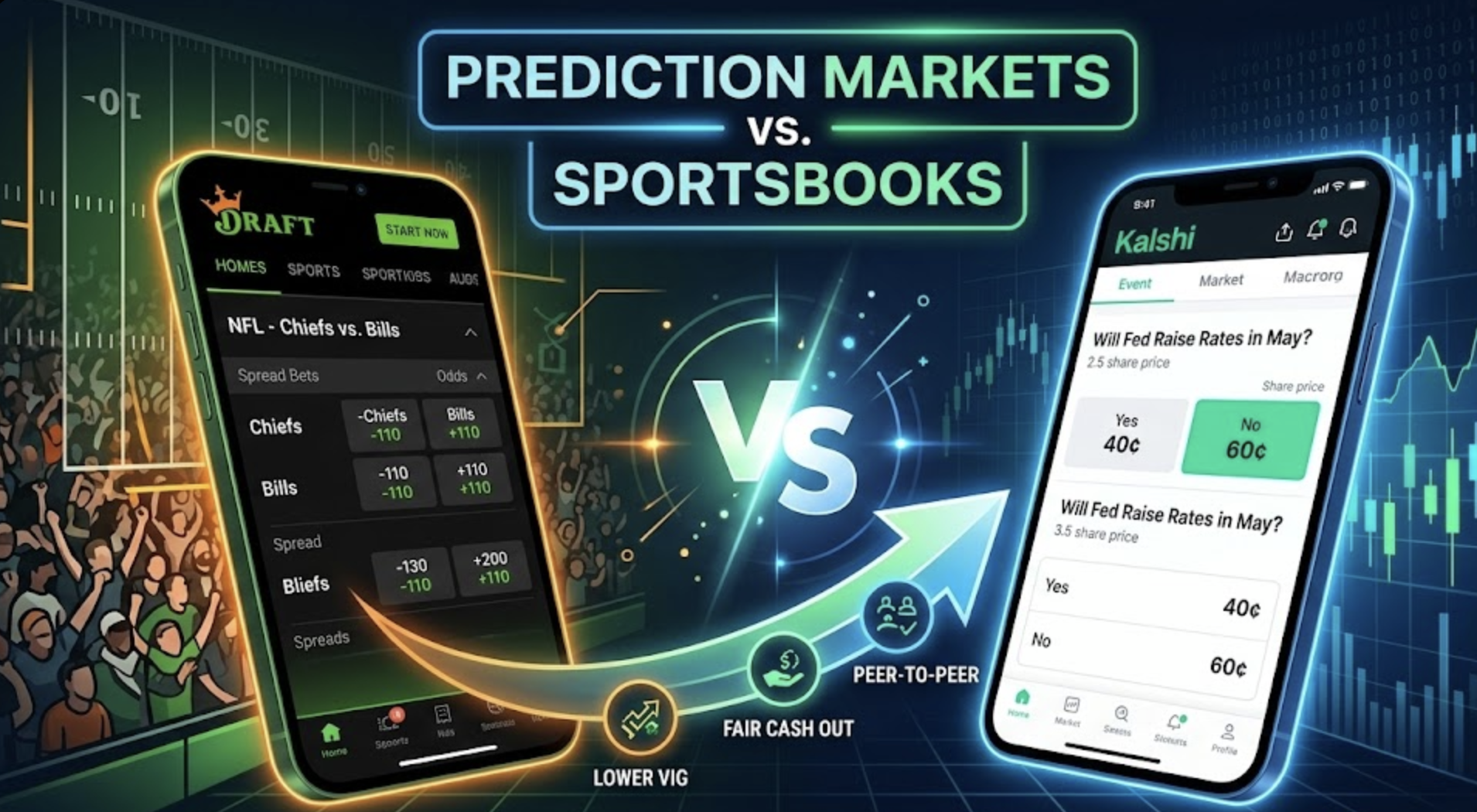
Polymarket vs Kalshi 2026: Side-by-Side Comparison for Real Traders
Fees, liquidity, market selection, withdrawal speed, US legality, mobile app. The unsentimental head-to-head between the two biggest prediction markets — and which one wins for which type of trader.
If you're trying to choose between Polymarket and Kalshi in 2026, the short answer is "it depends on what you're trading and where you live." The longer answer is what this post is about. We'll go through every dimension that actually matters — fees, liquidity, market selection, regulatory status, withdrawal speed, mobile apps, customer support — and tell you which platform wins for which type of trader.
This is also the year the question changed shape. Polymarket's 2026 launch of its CFTC-regulated US exchange (Polymarket US) means American traders now have three options instead of two: Kalshi, Polymarket US, or Polymarket Global (offshore, US-blocked). We'll cover all three.
Snapshot: The 60-Second Comparison
| Dimension | Polymarket Global | Polymarket US | Kalshi |
|---|---|---|---|
| Regulator | None (offshore) | CFTC (DCM) | CFTC (DCM) |
| US users | Blocked | Allowed | Allowed |
| Settlement asset | USDC (Polygon) | USD | USD |
| Peak taker fee | 1.8% (Crypto) | 0.30% flat | 1.75% (Crypto) |
| Maker fee/rebate | Zero | -0.20% rebate | Zero / near-zero |
| Funding | Crypto bridge | ACH (free) | ACH (free) |
| Withdrawal | USDC, ~$0.02 gas | ACH (free) | ACH (free) |
| Markets (count) | 5,000+ | 200+ (growing fast) | 800+ |
| Top categories | Politics, crypto, geopolitics | Politics, economics | Sports, economics, politics |
| Mobile app | Yes | Yes | Yes |
| Tax forms | None (offshore) | 1099-MISC/B | 1099-MISC/B |
Fees: The Math That Actually Matters
Fees are where the platforms differ most, and the difference compounds quickly for active traders.
Polymarket Global
Category-based taker fee following a multiplier × p × (1-p) curve. Peak fee at 50¢:
- Sports: ~0.75%
- Politics: ~1.0%
- Economics: ~1.5%
- Crypto: ~1.8%
- Geopolitics: 0% (free)
Maker orders are free in all categories. See our full Polymarket fees guide.
Polymarket US
Flat-rate model regardless of market category:
- Taker: 0.30%
- Maker: -0.20% rebate (you receive a payment for adding liquidity)
This is by far the cheapest mainstream prediction market for retail US users. The maker rebate alone is unusual — most exchanges have zero-fee makers, not negative-fee makers.
Kalshi
Same multiplier × p × (1-p) curve as Polymarket, with multipliers in the 6–7% range. Peak fees at 50¢:
- Most categories: ~1.5%
- Crypto: ~1.75%
Maker orders effectively free due to the rounding floor. See our Kalshi fees guide.
Real-Dollar Examples
Trading $500 on a politics market at 60¢:
| Platform | Taker Fee | Net Cost |
|---|---|---|
| Polymarket Global | $2.40 | $502.40 |
| Polymarket US | $1.50 | $501.50 |
| Kalshi | $3.36 | $503.36 |
Trading $500 on a sports market at 50¢ (peak fee scenario):
| Platform | Taker Fee | Net Cost |
|---|---|---|
| Polymarket Global | $3.75 | $503.75 |
| Polymarket US | $1.50 | $501.50 |
| Kalshi | $7.50 | $507.50 |
Verdict on fees: Polymarket US wins on a per-trade basis nearly always. Polymarket Global wins on sports against Kalshi. Kalshi is in the middle on most categories.
For traders who place 100+ trades per month, the fee delta between Kalshi and Polymarket Global on sports is on the order of $50–$200 per month at moderate volume. For occasional traders, it's nearly noise.
Liquidity: Where Each Platform Is Deepest
Liquidity is harder to compare cleanly because it varies enormously market-by-market. Here are the patterns that hold consistently:
Polymarket Global — strongest on:
- Political markets (US elections, world leader races, geopolitical resolution)
- Crypto markets (BTC/ETH/SOL price levels, blockchain milestones)
- Geopolitics (military, diplomatic resolution markets)
- Markets denominated in "obscure" probabilities (1¢/99¢ tail bets often have surprisingly deep books on Polymarket)
Kalshi — strongest on:
- Sports event contracts (NFL games, NBA games, MLB, NHL, soccer)
- US economic indicators (CPI, jobs report, Fed rate decisions)
- US political prediction markets (especially congressional and state-level races where Polymarket sometimes doesn't list)
- Weather markets (high-temperature day counts, hurricane formation)
Polymarket US — still building:
- Strongest on politics so far (inherits the user base interest)
- Smaller catalog than Kalshi or Polymarket Global in May 2026, but adding contracts rapidly
- Liquidity thinner than the other two on most markets — improving over time
Verdict on liquidity: depends entirely on what you're trading. Sports trader? Kalshi. Political prediction trader who's not US-based? Polymarket Global. Geopolitics? Polymarket Global. Don't try to use one platform for everything if you can use both.
Market Selection: Breadth vs Depth
The catalogs differ in shape, not just size.
Polymarket Global has the largest absolute count — 5,000+ active markets — but a long tail of low-liquidity contracts. Strong selection in:
- Every major election globally
- AI/AGI prediction markets (timelines, model releases, capability milestones)
- Crypto-native questions (token unlocks, network milestones)
- Cultural events (Oscars, music awards, "will X happen by date Y")
Kalshi has ~800 active markets, curated and focused. Strong in:
- Every US sport at the league level (NFL games, NBA games, etc.)
- Every US economic release (CPI, GDP, employment, Fed actions)
- US-centric political markets at congressional and state level
- Weather and climate (uniquely deep here)
Polymarket US has the smallest catalog (~200 active markets) but growing fast. Currently strongest in politics; adding economics and selective sports through 2026.
Verdict on selection: Polymarket Global for breadth, Kalshi for US-domestic depth, Polymarket US for political markets with regulatory protection.
Funding and Withdrawals
This is where Kalshi has a genuine edge for US users, and where Polymarket US is now catching up.
Polymarket Global
- Deposit: bridge USDC onto Polygon, then deposit to Polymarket's smart contract. Coinbase → Polymarket flow takes ~2 minutes and costs ~$0.02 in gas.
- Withdrawal: send USDC out of Polymarket on Polygon. Same ~2 minutes, ~$0.02 gas.
- To/from bank: requires a CEX as intermediary. Total round-trip is 5 minutes to 3 days depending on ACH vs. wire.
Polymarket US
- Deposit: free ACH from your bank, 1–3 business days for new accounts, instant once verified.
- Withdrawal: free ACH to your bank, 1–3 business days.
- No crypto involved at all.
Kalshi
- Deposit: free ACH from your bank, identical timing to Polymarket US.
- Withdrawal: free ACH to your bank, identical timing.
- No crypto involved.
Verdict on funding: Kalshi and Polymarket US tie on funding ease for US users — both are essentially "regulated US brokerage" UX. Polymarket Global is great if you live in crypto-native infrastructure already; clunky if you don't.
US Legality
Direct comparison:
- Polymarket Global: blocks all US users via IP and KYC. Using a VPN violates ToS and risks account freeze.
- Polymarket US: CFTC-regulated DCM, available to US residents in most states.
- Kalshi: CFTC-regulated DCM, available to US residents in most states.
Both Polymarket US and Kalshi face state-level pushback on sports event contracts (especially in Nevada and New Jersey). Both are litigating their way through these challenges. The legal status of each is roughly identical for non-sports markets and similarly contested on sports markets.
Verdict on legality: Polymarket US and Kalshi are equivalent for US users. Polymarket Global is off-limits.
User Experience and Mobile
Polymarket Global
- Polished crypto-native UX. Wallet connection, MetaMask integration, Polygon-native order flow.
- Mobile app available; functional but not the highlight of the platform.
- Best for users comfortable with crypto wallets.
Polymarket US
- Cleaner, more brokerage-like UX than Global. No wallets, just USD balances.
- Mobile app at parity with web.
- Best for users who want Polymarket's market style without crypto.
Kalshi
- Most "polished" UX in the prediction market space — feels like a modern fintech brokerage app (Robinhood-adjacent).
- Mobile app is genuinely excellent. Many users report doing 80%+ of their trading from the phone.
- Best for users coming from sports betting apps or stock trading apps.
Verdict on UX: Kalshi for polish, Polymarket US for second place, Polymarket Global if you live in crypto already.
Tax Reporting
For US traders, this is non-trivial.
- Polymarket Global: issues no US tax forms. You must self-report all gains/losses. Export trade history before year-end.
- Polymarket US: issues 1099-MISC and/or 1099-B as a regulated DCM. Same paperwork as any US brokerage.
- Kalshi: issues 1099-MISC and/or 1099-B. Same.
If you're a US user, Polymarket US and Kalshi are dramatically simpler at tax time. For a deep dive, see prediction market taxes 2026.
Customer Support
Anecdotal but consistent across user reports:
- Kalshi: responsive, US-based, available via email and in-app chat. Most issues resolve in 24–48 hours.
- Polymarket US: similar to Kalshi — newer team, but US-domiciled and responsive.
- Polymarket Global: support exists via email and Discord, but response times are slower and the support team has limited authority to override smart contract behavior. If your issue requires moving funds, expect days, not hours.
Verdict on support: Kalshi by a noticeable margin, Polymarket US second, Polymarket Global third.
Which Should You Use?
The right answer depends on three things: where you live, what you trade, and how often you trade.
Use Kalshi if:
- You're a US resident
- You trade sports event contracts
- You want the smoothest mobile/funding UX
- You value regulatory clarity and US tax forms
Use Polymarket US if:
- You're a US resident
- You're primarily a political markets trader
- You want the lowest fees among US-regulated platforms (0.30% flat + maker rebate)
- You want regulatory protection but Polymarket-style market selection
Use Polymarket Global if:
- You live outside the US
- You trade across many categories (politics, crypto, geopolitics, cultural)
- You're comfortable with crypto wallets and Polygon
- You want the deepest political market liquidity globally
Use multiple if:
- You're an active trader looking for cross-platform arbitrage opportunities
- You want the best price on every trade, regardless of platform
- You're hedging positions or running market-neutral strategies
Most professional prediction market traders use at least two platforms. The fees you save by getting the better price on each trade — and the arbitrage opportunities that arise when the same market trades at different prices on different platforms — far exceed the friction of maintaining two accounts.
The Cross-Platform Edge
When the same contract trades at 64¢ on Polymarket Global and 67¢ on Kalshi, there's a 3¢ price difference per contract. On a 1,000-contract trade, that's $30 of edge for buying on the cheaper platform. These gaps appear constantly, especially on:
- US political markets (Polymarket Global often slightly different from Polymarket US/Kalshi)
- Sports markets (Kalshi vs Polymarket Global before game start)
- Crypto price markets (especially right after a fast price move)
Tracking them manually is tedious. Prediction Hunt's cross-platform comparison tool shows you in real time which platform has the best price for any given market, plus arbitrage opportunities when the YES on one and NO on the other sum to less than $1.00.
Bottom Line
You don't have to pick. The two platforms (or three, if you count Polymarket Global separately from Polymarket US) cover different ground and complement each other. For most traders the right answer is:
- Open a Kalshi account for sports and US-domestic markets.
- Open a Polymarket US account for politics with regulatory cover.
- (If outside the US) open a Polymarket Global account for everything else.
- Use a cross-platform comparison tool to never overpay relative to the best available price.
The fee, regulatory, and liquidity differences are real but rarely large enough to make one platform "wrong" — they're large enough that picking the right one for any given trade matters a lot.
Build with this data
Automate your strategies, create arb bots, or build your own dashboard. Free tier includes 1,000 requests/mo across all prediction market platforms.
Free Trading Tools
View allCompare fees across Kalshi, Polymarket & PredictIt.
Find fair probabilities with the overround removed.
See if a trade has positive EV before you enter.
Convert American, decimal & implied probability.
Combined odds and payouts for multi-leg bets.
Your real take-home after fees and taxes.
Related Posts
How to Short on Prediction Markets: The Mechanics Explained
Prediction markets don't have a 'short' button — you express a short view by buying NO or by selling YES shares you own. Here's exactly how it works on Polymarket and Kalshi, with examples.
9 min readRead
Kalshi Fees 2026: Complete Guide to Trading, Deposit & Withdrawal Costs
Kalshi's peak taker fee is 1.75%, but most trades cost far less. Here's the full P×(1-P) formula, category-by-category fees, maker rebates, and how to keep your costs under 0.5% per trade.
9 min readRead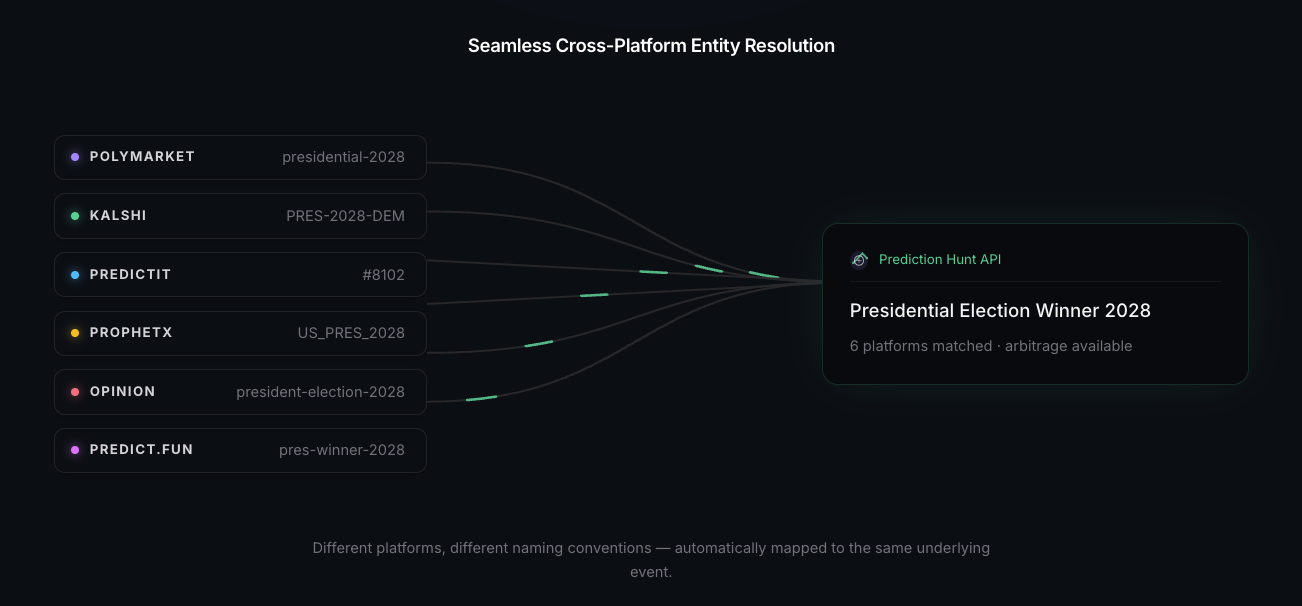
Prediction Market Glossary: 40 Terms Every Trader Should Know
From 'implied probability' to 'thick book' — the complete A-to-Z reference for prediction market terminology, with concrete examples on Polymarket and Kalshi.
12 min readRead