
Prediction Market Glossary: 40 Terms Every Trader Should Know
From 'implied probability' to 'thick book' — the complete A-to-Z reference for prediction market terminology, with concrete examples on Polymarket and Kalshi.
Prediction markets borrow terminology from financial exchanges, sports betting, and statistics — which makes the vocabulary genuinely confusing for newcomers. This glossary covers the 40 terms you'll encounter most often on Polymarket, Kalshi, and the other major venues, with concrete examples wherever helpful.
Use the A-Z structure below to jump to a specific term, or read it through once to get a working command of the field's vocabulary.
A
Arbitrage
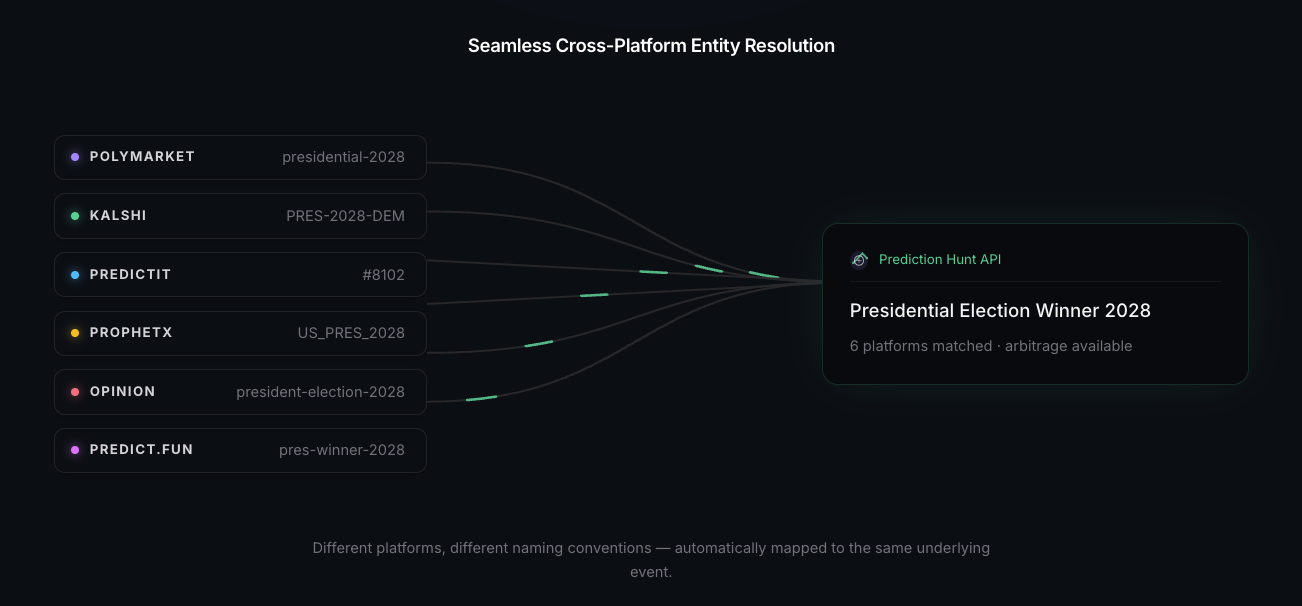
A guaranteed-profit trade created by price discrepancies across markets or platforms. The classic form: buy YES on Polymarket at 64¢ and NO on Kalshi at 35¢. Combined cost: 99¢. Combined payout: $1.00 (since one side must resolve true). Risk-free profit: 1¢ per contract, minus fees. In practice, finding sustained arbitrage opportunities is hard — exchanges' market makers close most gaps within seconds. See our arbitrage guide for execution mechanics.
Ask
The lowest price at which someone is currently willing to sell a contract. If the ask on YES is 67¢, that's what you pay if you place a market order to buy YES. Also called the "offer."
At-the-Money (ATM)
A contract trading at or near 50¢. The market is implying roughly 50/50 odds — maximum uncertainty. Fees on most platforms peak at ATM because the P×(1-P) curve maximizes there.
B
Bid
The highest price at which someone is currently willing to buy a contract. If the bid on YES is 65¢, that's what you receive if you place a market order to sell YES. The gap between the bid and the ask is the spread.
Binary Contract
A contract with two possible outcomes: YES (pays $1.00) or NO (pays $1.00 to NO holders). The vast majority of prediction market contracts are binary. Multi-outcome contracts (e.g., "who wins the 2028 election" with 5 candidates) are typically structured as 5 separate binary contracts, one per candidate.
Book
Short for "order book" — the list of all resting limit orders on a market, organized by price and side. The book shows market depth, the spread, and where significant liquidity is concentrated.
C
Combo / Parlay
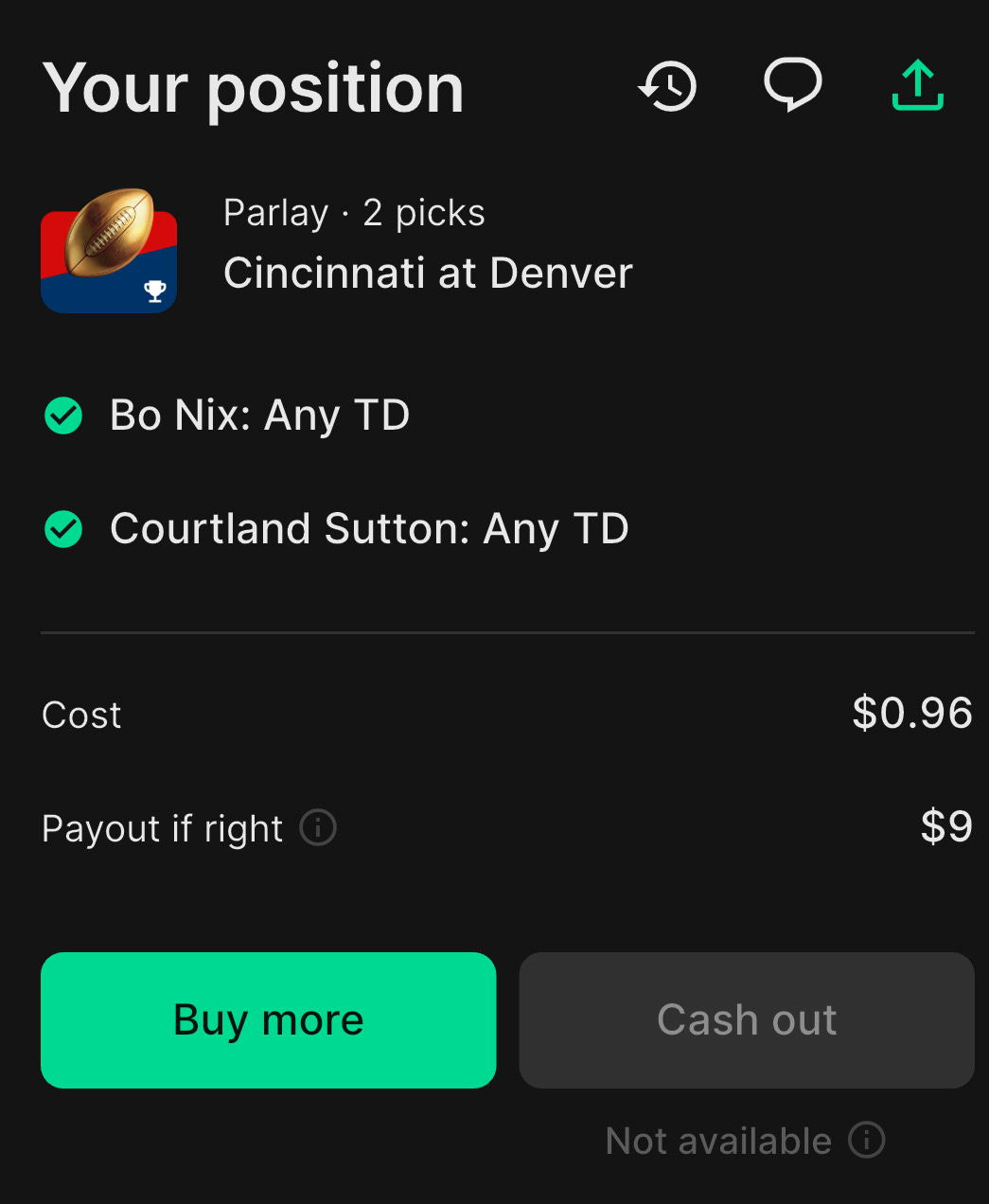
A multi-leg contract where you bet on multiple events all resolving in your favor. Kalshi offers native combos; Polymarket does not. The combo pays out only if every leg resolves YES (or the specified outcome for each). See our Kalshi combos guide for the full mechanics and pricing math.
Contract
The atomic unit of a prediction market. One contract pays $1.00 if its specified condition resolves true, $0.00 otherwise. Prices trade between $0.00 and $1.00 (or 0¢ and 100¢, depending on the platform's display preference).
CFTC
The Commodity Futures Trading Commission. The US federal regulator with jurisdiction over derivatives, including event contracts. Polymarket US and Kalshi both operate as CFTC-licensed Designated Contract Markets (DCMs).
D
Designated Contract Market (DCM)
A CFTC-licensed exchange authorized to list derivatives contracts. Polymarket US and Kalshi are DCMs. The same regulatory framework covers CME, CBOE, and ICE. State gambling regulators have historically argued that DCM authority doesn't preempt state sports betting law — this is being litigated.
Depth
How much volume can trade at or near the current price before the price moves significantly. A market with $50,000 in depth at the touch can absorb a $5,000 market order with minimal price impact. A market with $200 of depth at the touch will move several cents on a $1,000 order.
Discretionary Resolution
A resolution decision made by the platform (not by an objective on-chain or off-chain oracle) when the underlying event has ambiguity. Polymarket uses UMA's optimistic oracle for most markets; Kalshi uses internal resolution by its market operations team. Discretionary calls are rare but contentious when they happen.
E
Edge
Your expected profit margin on a trade, expressed in cents or percent. If a contract is trading at 60¢ and you believe its true probability is 65%, your edge is 5¢ per contract — roughly an 8% expected return on capital risked. Edge is the only thing that matters in the long run; everything else is noise.
Expected Value (EV)
The probability-weighted average payoff of a trade. For a contract trading at 60¢ with a true probability of 65%, the EV per contract is (0.65 × $1.00) + (0.35 × $0.00) - $0.60 = $0.05, or +8.3% on cost. Positive EV (+EV) trades are the goal; negative EV (-EV) trades lose you money in expectation.
F
Fade
To bet against a popular position. If the crowd is buying YES heavily at 70¢ and you think they're wrong, you "fade the move" by selling YES (or buying NO). Often associated with sharper traders pushing back against retail flow.
Fees
What the platform charges for executing a trade. Most prediction markets use a P×(1-P) formula that peaks at 50¢ and tapers toward the extremes. See our Polymarket fees guide and Kalshi fees guide for full breakdowns.
Fill
When your order executes. A "full fill" means your entire order quantity traded. A "partial fill" means only some of your order executed; the rest is either resting on the book (limit order) or canceled (market order with insufficient liquidity).
G
Gas
The transaction fee paid to a blockchain network for processing a trade or transfer. On Polymarket Global (Polygon network), gas is typically a few cents in MATIC. On Ethereum mainnet, gas can be $5–$50+. Kalshi and Polymarket US don't expose gas to users — they operate on traditional infrastructure.
H
Half-Kelly
A position-sizing strategy that uses 50% of the Kelly Criterion's recommended bet size. Reduces variance at the cost of slightly lower long-run growth. Most professional prediction-market traders use fractional Kelly (half or quarter) because the Kelly formula assumes perfect probability estimation, and real-world estimates have error bars. See our Kelly criterion guide for the math.
I
Implied Probability
The probability the market price implies for an event. A YES contract at 65¢ implies a 65% probability that YES resolves true. This is the market's collective estimate — your job as a trader is to identify when your estimate diverges from the market's.
In-the-Money (ITM)
A contract that would currently pay out if resolved at this instant. For a YES contract, ITM means the YES condition is currently true. ITM contracts trade above 50¢; out-of-the-money (OTM) contracts trade below 50¢. The vocabulary is borrowed from options trading.
K
Kelly Criterion
A mathematical formula for optimal position sizing given a known edge and odds. The full Kelly bet is (p × b - q) / b where p is your win probability, q = 1 - p, and b is the odds. Bet larger than Kelly and you risk ruin; bet smaller (e.g., half-Kelly) and you give up growth for variance reduction. The optimal-growth answer in theory; the unstable answer in practice when probability estimates are uncertain.
KYC (Know Your Customer)
The verification process exchanges use to confirm user identity, comply with anti-money-laundering laws, and (for US exchanges) restrict access to certain jurisdictions. Polymarket Global has light KYC for small accounts and heavier KYC for high-volume traders. Polymarket US and Kalshi require full KYC at signup.
L
Limit Order
An order to buy or sell at a specific price (or better). If you place a limit buy at 62¢ and the current ask is 65¢, your order rests on the book until someone is willing to sell at 62¢. Limit orders pay maker fees (often $0.00) instead of taker fees, but may never fill.
Liquidity
The total volume of resting orders near the current price. High liquidity means tight spreads and minimal slippage on large trades. Low liquidity means wide spreads and significant price impact on even small orders. See how to evaluate liquidity for what to check before placing large orders.
Long
A position that profits if the underlying event resolves favorably. Buying YES is "going long YES." Buying NO is going long NO (and is functionally equivalent to going short YES).
M
Maker
A trader who places a limit order that rests on the book until someone else takes the other side. Makers add liquidity to the market. Most exchanges charge lower fees (or pay rebates) to makers because liquidity is what makes the market function.
Market Order
An order to buy or sell immediately at whatever the current best price is. Market orders fill instantly but pay taker fees and incur slippage if depth is thin. Use them when speed matters more than price; use limit orders otherwise.
Mid (Midpoint)
The average of the best bid and best ask. If bid is 60¢ and ask is 64¢, the mid is 62¢. Mid is the "fair" price between the two visible sides of the market. Some quote feeds use mid instead of bid/ask for charting purposes.
N
NO
A contract that pays $1.00 if the underlying event does not resolve as stated. NO contracts trade between $0.00 and $1.00, and the price of YES plus the price of NO always equals roughly $1.00 (plus or minus the spread). Buying NO is mechanically the same as betting against the event.
Notional
The total dollar value of a position. If you hold 1,000 YES contracts at 60¢ each, your notional is $600. Used to standardize comparisons across positions of different sizes and prices.
O
Odds
The market's pricing expressed as the ratio of one outcome to the other. A YES contract at 70¢ has implied odds of 70:30, or 7-to-3 favored. Sportsbook-style "American odds" can be derived from prediction market prices: a YES at 65¢ corresponds to -186 American odds (you bet $186 to win $100).
Order Book
The full list of resting limit orders organized by price and side. The book shows where bids and asks are stacked, how deep the liquidity is, and where significant resistance might appear if the price moves.
Out-of-the-Money (OTM)
A contract that would currently pay nothing if resolved at this instant. OTM contracts trade below 50¢ on most prediction-market platforms. Buying OTM is a "longshot" bet — low cost per contract, low probability of payoff, high return ratio if it hits.
P
Position
The contracts you currently hold in a market. A "long position in YES" means you own YES contracts and benefit if YES resolves. A "flat" position means you hold no contracts.
Premium
The amount you pay for a contract. A YES contract at 67¢ has a premium of 67¢. The contract's maximum payout is $1.00, so the premium represents both your cost and your max loss.
R
Resolution
The process by which a market is settled and contracts pay out (or expire worthless). Polymarket uses UMA's optimistic oracle; Kalshi uses internal operations. Resolution can take seconds (after an event clearly occurs) or weeks (for markets with ambiguous criteria).
Resolver / Oracle
The mechanism that determines the final outcome of a market. Polymarket uses UMA's decentralized oracle network. Kalshi uses an internal team. Other platforms use various combinations. Disputes over resolution are rare but high-stakes when they occur.
Rolling
Closing a position in an expiring contract and opening an equivalent position in a longer-dated contract. Common in markets like "will X happen by [date]" where one contract expires and a longer-horizon version becomes the active market.
S
Settlement
The final payout step after resolution. Contracts that paid YES receive $1.00 per share; contracts that paid NO receive $0.00. Settlement happens automatically once the resolver assigns the outcome.
Short
A position that profits if the underlying event does NOT resolve as stated. On Polymarket, you go "short YES" by buying NO contracts (or, if you already own YES, selling those YES contracts). Most prediction markets don't have explicit short-selling — you express a short view by buying the opposite side. See how to short on prediction markets for the full mechanics.
Slippage
The difference between the price you expected and the price you actually got. If you place a market order for 500 shares expecting to pay 65¢ but the average fill is 67¢, your slippage is 2¢ per share. Caused by thin order books and large order size relative to depth.
Spread
The difference between the best bid and the best ask. A 2¢ spread (bid 64¢, ask 66¢) is tight; a 10¢ spread is wide. Tight spreads mean low transaction cost; wide spreads mean you pay several percent just to enter and exit a position.
T
Taker
A trader who places an order that immediately fills against the existing book — either a market order or a limit order priced aggressively enough to cross the spread. Takers consume liquidity and pay higher fees than makers.
Tick
The smallest price increment a market can move. Most prediction markets use a 1¢ tick (prices in $0.01 increments). Tighter ticks mean more granular pricing; wider ticks make spreads structurally wider.
Tight Book
A market with very small spread (1¢ or less) and substantial depth at the touch. Indicates active market making and a healthy, liquid contract. The opposite — a "wide" or "thin" book — indicates low participation.
TVL (Total Value Locked)
The total dollar value of open positions in a market. Sometimes used as a proxy for market interest. High TVL on a contract suggests broad consensus around the question's importance; low TVL on a near-resolution contract is a warning sign about liquidity for exits.
U
UMA
The decentralized oracle protocol Polymarket uses for resolving markets. UMA holders propose outcomes; disputes are settled by a voting mechanism. UMA's "optimistic oracle" works fast in normal cases but can take days when disputed.
V
Volume
The total amount of trading activity in a market over a specified time window (24h, 7d, etc.). High volume = active market, narrow spreads, easier execution. Low volume = thin book, wider spreads, harder to enter or exit large positions.
Volatility
How much a contract's price moves over time. High-volatility markets see large day-to-day swings (election prediction markets right before a vote, for example). Low-volatility markets stay close to a stable level (markets that aren't close to resolution, with prices well above 90¢ or well below 10¢).
W
Wash Trade
A trade where the same trader is on both sides — buying from themselves to fake volume or manipulate price. Prohibited on regulated exchanges (Polymarket US, Kalshi). Harder to detect on decentralized platforms but increasingly addressed by surveillance.
Wide Book
A market with wide spread (often 5¢+) and minimal depth at the touch. Indicates illiquidity. Avoid large orders on wide-book markets unless you're willing to absorb several cents of slippage on both entry and exit.
Y
YES
A contract that pays $1.00 if the underlying event resolves true. YES contracts trade between $0.00 and $1.00. Buying YES is the "bet on this happening" side of every binary market.
Bringing It Together
These 40 terms cover roughly 95% of the vocabulary you'll encounter on Polymarket, Kalshi, and other prediction markets. The handful you'll use every single day:
- Bid, ask, spread, depth — to evaluate execution quality
- Implied probability, edge, expected value — to think about whether a trade is worth taking
- Maker, taker, market order, limit order — to control execution cost
- YES, NO, long, short — to express your view
If you're comfortable with those 12 concepts, you're functionally equipped to trade. Everything else fills in over time.
For real-time prices and the cross-platform comparisons that make terms like "spread" and "arbitrage" tangible, Prediction Hunt's market dashboard is the fastest way to see this vocabulary applied to live markets.
Build with this data
Automate your strategies, create arb bots, or build your own dashboard. Free tier includes 1,000 requests/mo across all prediction market platforms.
Free Trading Tools
View allCompare fees across Kalshi, Polymarket & PredictIt.
Find fair probabilities with the overround removed.
See if a trade has positive EV before you enter.
Convert American, decimal & implied probability.
Combined odds and payouts for multi-leg bets.
Your real take-home after fees and taxes.
Related Posts
How to Short on Prediction Markets: The Mechanics Explained
Prediction markets don't have a 'short' button — you express a short view by buying NO or by selling YES shares you own. Here's exactly how it works on Polymarket and Kalshi, with examples.
9 min readRead
Kalshi Fees 2026: Complete Guide to Trading, Deposit & Withdrawal Costs
Kalshi's peak taker fee is 1.75%, but most trades cost far less. Here's the full P×(1-P) formula, category-by-category fees, maker rebates, and how to keep your costs under 0.5% per trade.
9 min readRead
Polymarket vs Kalshi 2026: Side-by-Side Comparison for Real Traders
Fees, liquidity, market selection, withdrawal speed, US legality, mobile app. The unsentimental head-to-head between the two biggest prediction markets — and which one wins for which type of trader.
9 min readRead